How many people in Croatia speak English?
Croatia is a country where history, tradition, and tourism collide. Croatian is the official language, but with globalization, EU membership, and a booming tourism industry, English has taken on a new role in daily life. From an early age, Croatian students are introduced to English, and many go on to use it in their studies and careers. But how many people in Croatia actually speak it fluently?
Out of the 4,555,000 people in Croatia, approximately 2,600,000 of them speak English, which works out as a very reasonable 60%. What’s more, Croatia has an outstanding English proficiency score, coming in at 607 out of 700.
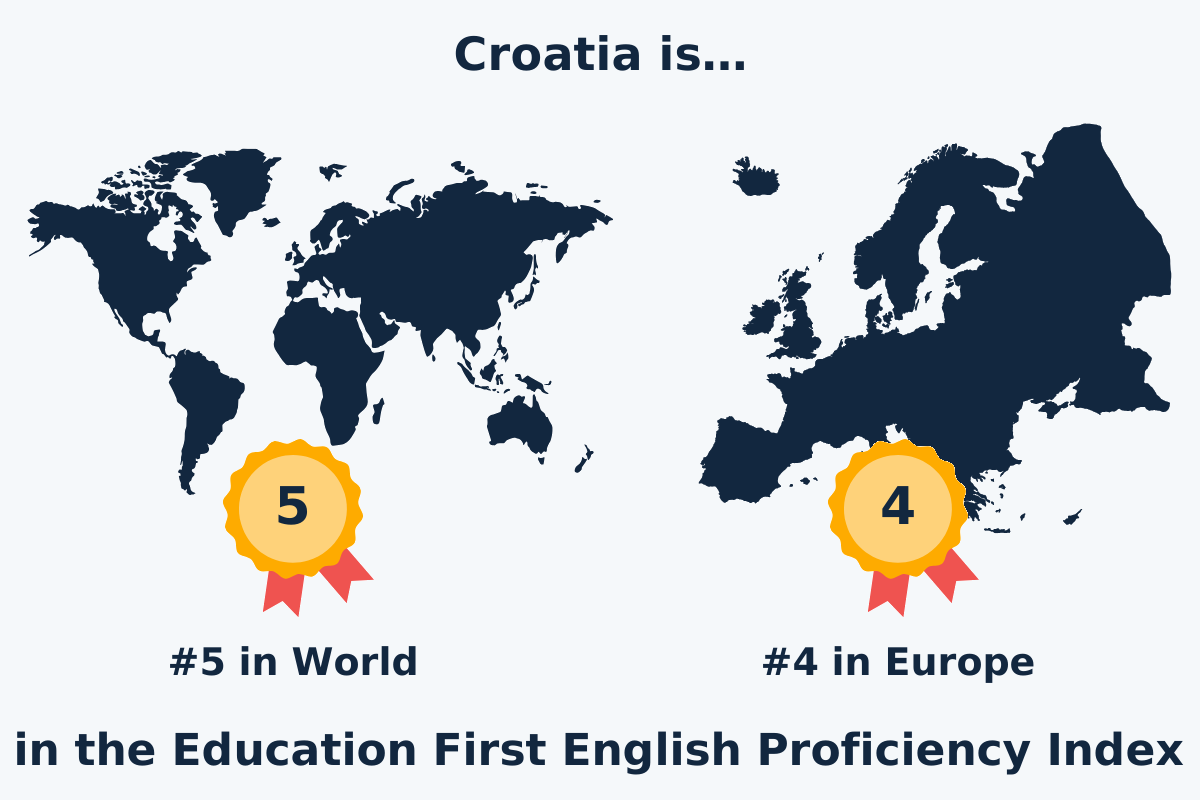
To put that into perspective, their score is 130 points more than the global average score which comes in at 477 points out of 700. Their score makes them number 5 across the globe, and number 4 in Europe.
Source: Wikipedia
However, as with any statistic, there’s more to the story. Age, education, region, and even gender all play a role in how widely and confidently English is spoken across the country. Read on to find out more!
You can also find out how many people in Taiwan speak English!
English Speakers in Croatia (General Stats)
Croatia may be a relatively small country, but it does remarkably well in terms of relative English proficiency. Here are a few general stats on the topic.
- Out of the 4,555,000 people in Croatia, approximately 2,600,000 people can speak English. Or in other words, 60% of the population.
- Croatia has an English proficiency score of 607 is 130 points higher than the global average.
- In 2024, Croatia ranked #5 in world and #4 in Europe for English proficiency.
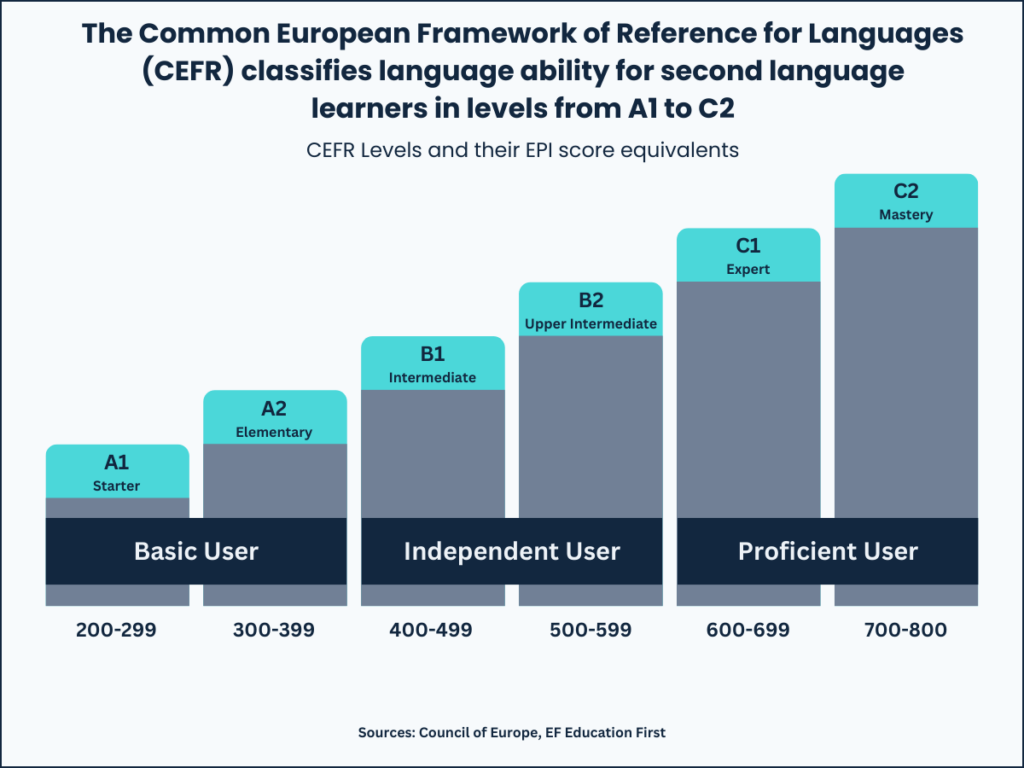
- Croatia’s EPI score of 607 puts them in the CEFR C1 category, which means very high proficiency.
- Croatia’s EPI score has improved considerably over the years, but from 572 points in 2018 up to 607 in 2024, a difference of 35 points.
- Croatian scores in English proficiency for women have been very close to those of men between 2018 and 2024, with rarely more than 30 points between them.
- According to Eurobarometer, 76% of Croatians think English is the most useful language for their personal development.
- The capital city of Zagreb reached an EPI score of 626 points out of 800 in English proficiency in 2024, meaning very high proficiency.
Sources: Wikipedia, EF English Proficiency Index, CEFR, Eurobarometer
Croatia ranks impressively high in global English proficiency indexes, with an average English proficiency score of 607, which puts them at a CEFR level of C1, meaning high proficiency. To put that into context, an English proficiency score of 600 is over 100 points higher than the global average, which comes in at 477 points out of a possible 700.
According to the figures, it’s safe to assume that the average Austrians over the age of 18 speaks English at a high level, or more specifically, the equivalent of a C1 level on the CEFR scale. What this means in real-world terms is that most Hungarians:
- Can understand a wide range of demanding, longer texts, and recognise implicit meaning.
- Can express themselves fluently and spontaneously without much obvious searching for expressions.
- Can use language flexibly and effectively for social, academic and professional purposes.
- Can produce clear, well-structured, detailed text on complex subjects, showing controlled use of organisational patterns, connectors and cohesive devices.
You can also find out how many people in Mexico speak English!
Standard Croatian is the official language of Croatia followed closely by Standard Bosnian and Standard Serbian. However, children learn at least one foreign language, usually English, at around 1st grade and this becomes compulsory from the 4th grade.
The average score for English proficiency in Croatia has improved over the years. In 2018 they scored 572 points out of 700, which is already a high level of proficiency. But by 2024, this had gone up to 607 points, which is classed as very high. This is a difference of 35 points.
Source: EF English Proficiency Index
You can also find out how many people in India speak English!
Attitudes Toward Learning English in Croatia
When asked “Thinking about languages other than your mother tongue, which two
languages do you think are the most useful for your personal development?” 76% of those surveyed said English. This was followed by German which came in substantially lower at 39%.
When asked the same question but for their children to learn for their future, 88 percent answered English, which is very close to the average response for the whole European Union, which was 85%.
Here, on thoughts on the advantages of learning a new language, many of those surveyed highlight the ability to work in another country, and the ability to understand people from other cultures.
Despite this however, 58% of those surveyed said that they have not learned a language recently and don’t intend to start in the coming year.
Source: Eurobarometer
You can also find out how many people in Sweden speak English!
English Speakers in Croatia by Area
Due to Croatia being such a small country with a relatively small population, Education First were not able to provide details on English speaking proficiency in different regions, and the only city they had these details for in 2024 was the capital city of Zagreb, which had an EPI score of 626 points out of 700 in English proficiency, meaning very high proficiency. This is equivalent to a CEFR level of C1.
English Speakers in Croatia by Demographic Group
Due to Croatia being such a small country with a relatively small population, Education First were not able to provide details on English speaking proficiency in different age groups.
However they were able to collate data on the English proficiency of males and females. Males had the highest score in 2024, at 622 points out of 700, indicating a CEFR level of C1, and very high proficiency.
The score for women was slightly lower at 593 points out of 700, indicating a CEFR level of B2, and a high proficiency.
Conclusion
With around 60% of its population able to speak English and an English Proficiency Index score of 607, Croatia ranks among the top five countries in the world for English language skills. That’s an impressive achievement for a country of just 4.5 million people - especially considering that English isn’t an official language.
These figures place Croatia at a CEFR level of C1, which means that the average English-speaking Croatian is highly capable in not only everyday conversation, but also academic contexts, and professional settings.
The country’s emphasis on language learning starts early, with English introduced in primary school and continued throughout education. This long-standing commitment is clearly paying off, particularly in urban areas like Zagreb, where English proficiency is especially strong.
So, whether you’re visiting, studying, relocating, or doing business in Croatia, you can expect to find widespread English proficiency

Written by Richard Barker
Richard is an English teacher with over 25 years of experience. He has dedicated his life and career to his passion for English, literature, and pedagogy, guiding multiple generations of students on their journey to discovery.