How many people speak English in Poland?
Poland’s relationship with the English language has undergone significant transformation over the past century, shaped by shifting borders, political regimes, and educational reforms. Now, Poland is one of the European Union’s most populous member states, and it also positions itself as a regional hub for IT, finance, making the language a valuable career skill for upward social mobility.
But how many Poles today actually speak English fluently? Drawing on surveys such as the EF English Proficiency Index and Eurobarometer reports, this article provides a detailed look at how widely English is spoken in Poland and what factors contribute to the country’s current ranking.
The latest figures for the population show that there are approximately 38,501,000 people living in Poland, and of these, approximately 18,890,000 of them can speak English at a conversational level, which works out at a substantial 49 percent.
Source: Autolingual
However, as with any statistic, there’s more to the story. Age, education, region, and even gender all play a role in how widely and confidently English is spoken across the country. Read on to find out more!
If you’re curious about the figures for English speakers in other European countries, we’ve got those too. Check out what we have for Sweden, France, Germany, and Norway.
English Speakers in Poland (General Stats)
Most regions of Poland score in the “high” or “very high” proficiency categories, which means many Poles can comfortably hold a conversation in English, especially in cities and professional settings. Here are a few figures on the subject.
- There are 38,501,000 people living in Poland, and of these 18,890,000 of them can speak English, which is around 49%.
- English lessons became compulsory in Polish schools in the early 1960s at the secondary level and in higher education. Prior to that, Russian was the primary foreign language taught in Polish schools.
- Now, English lessons are compulsory in both secondary and primary schools, with children learning the language as young as 6 years old.
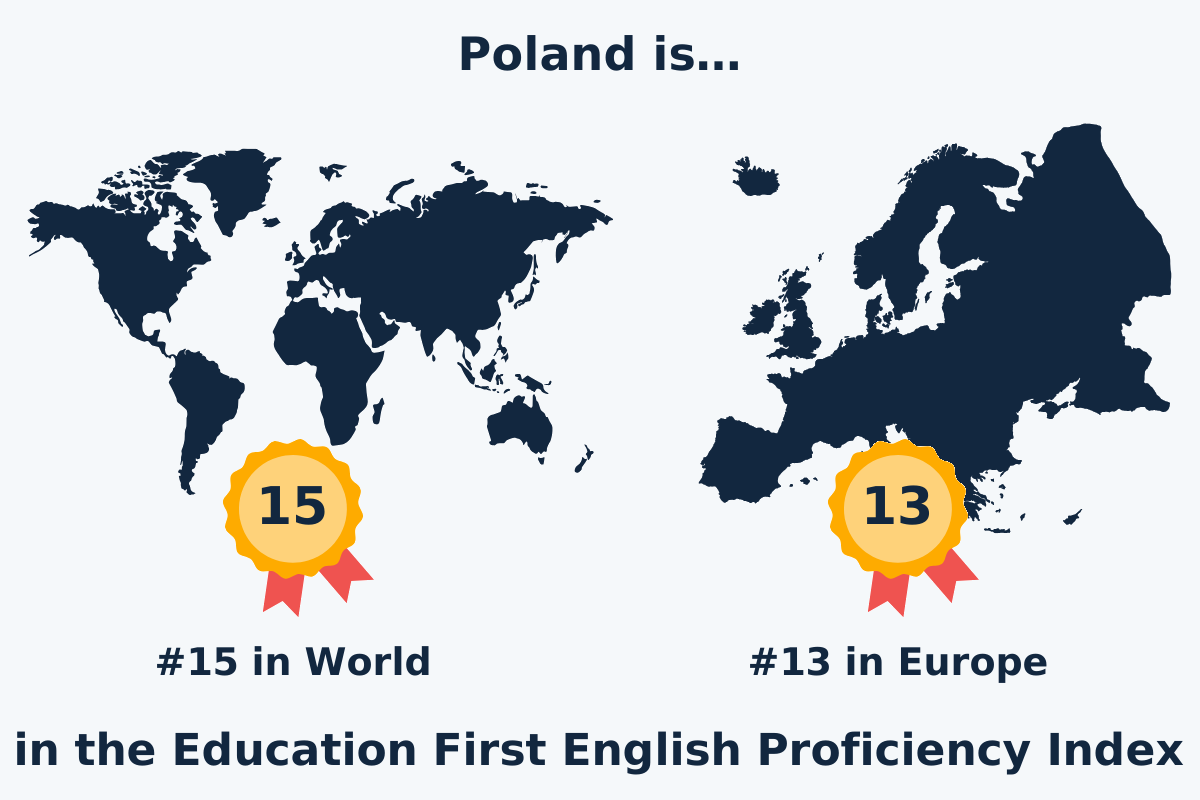
- Poland is ranked #15 out of 116 countries worldwide, and #13 out of 35 of European countries for English speaking proficiency.
- 18 percent of Poles said that they have never learned any language other than their mother tongue.
- 16 languages have been recognized as minority languages in Poland.
- English proficiency in Poland saw a steep increase between 2011 and 2014, but this has levelled off somewhat since, now falling at around 600 points.
- In 2024, there was a gap of 17 points in English proficiency scores between men and women, but this was not always the case (more on that shortly).
- Poland’s capital city of Warsaw has a very high English proficiency score of 612 points.
Sources: Autolingual, EF English Proficiency Index, CEFR, Eurobarometer
The roots of English proficiency in Poland go back several decades. English became a compulsory subject in secondary schools back in the 1960s, replacing Russian, which had been the dominant foreign language under Soviet influence.
Fast forward to today, and kids in Poland are learning English from as young as six years old, thanks to national education policies that now make English compulsory in both primary and secondary education.
On a global scale, Poland does very well when it comes to English proficiency. In the EF English Proficiency Index (EPI), Poland ranks:
- #15 out of 116 countries worldwide, and
- #13 out of 35 European countries.
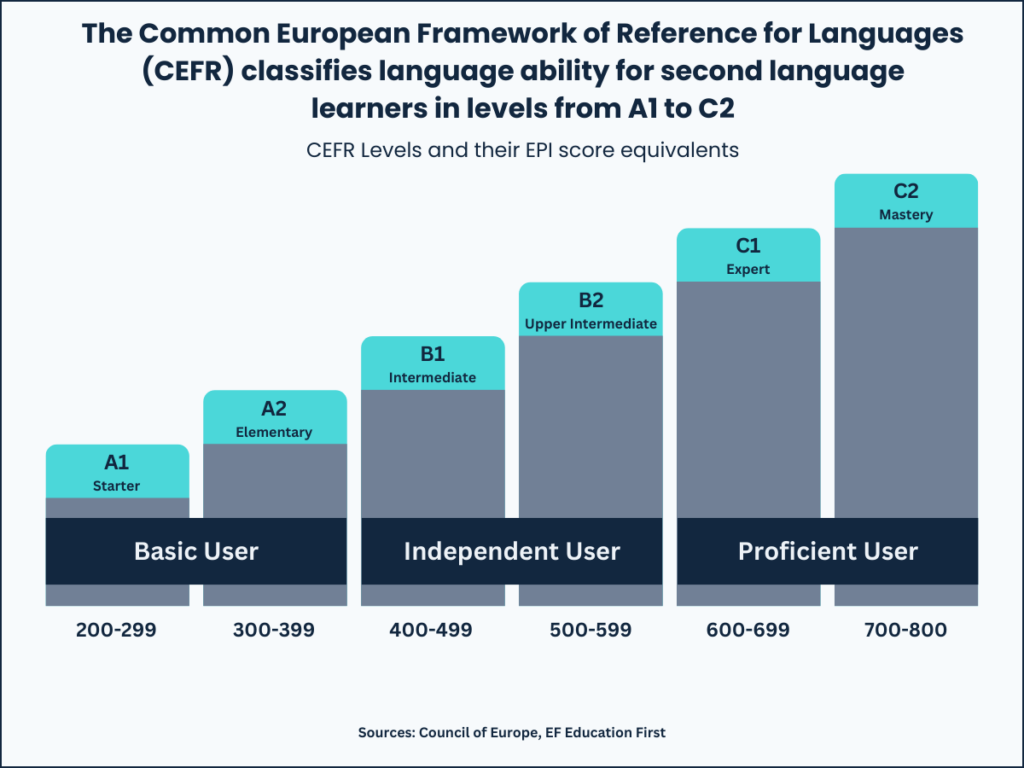
English proficiency in Poland saw a steep increase between the years of 2011 and 2014, but this has levelled off somewhat since, falling at around 600 points which is the borderline between very high and high, or more specifically, between B2 and C1 on the CEFR scale (more on that shortly).
To put that into context, Poland typically scores around 100 to 200 points higher on the English Proficiency Index than the global average, which is typically around the 500 point mark.
According to the figures, it’s safe to assume that the average Polish person over the age of 20 speaks English at a high level, or more specifically, the equivalent of a B2 on the CEFR scale. What this means in real-world terms is that most Polish people can:
-
Understand the main ideas of complex text on both concrete and abstract topics, including technical discussions in his/her field of specialisation
-
Interact with a degree of fluency and spontaneity that makes regular interaction with native speakers quite possible without strain for either party
-
Produce clear, detailed text on a wide range of subjects and explain a viewpoint on a topical issue giving the advantages and disadvantages of various options.
Sources: EF English Proficiency Index, CEFR, Eurobarometer
When and Why People Use English
According to Eurobarometer:
- 53% use it while traveling abroad
- 39% use it on the internet
- 15–17% use it for business or professional reasons
Also, 20% of Poles use translation tools regularly, so even if someone doesn’t speak English fluently, they likely have ways to bridge the gap.
Sources: Eurobarometer
Attitudes Toward English
When Poles were asked which foreign language they think is the most useful for personal development, 73% chose English. When the question was about their children, the number jumped to 83%. That’s a huge margin over the next most popular language, German, which came in at only 21% and 19%, respectively.
This speaks volumes about the cultural and practical importance of English in Poland - it’s not just a school subject, it’s a skill people value highly. When asked “What are the main advantages of learning a new language?”, the top answer was “To be able to work in another country” which came in at 50%. This was followed by a 41% score for “To get a better job in our country”.
That said, despite the widespread presence of English, 50% of people surveyed by Eurobarometer said that they’ve never truly learned another language, and that they don’t plan to start anytime soon. So while many Poles speak English, there’s still a significant part of the population that sticks almost solely to Polish.
Sources: Eurobarometer
English Speakers in Poland by Region
The region of Poland with the best English proficiency is Lesser Poland, which has an excellent EPI score of 610, which is very high.
The remaining regions surveyed scored at high levels, with most scoring only a few points under the 600 mark. Out of all the regions surveyed, the lowest performing region was Warmian-Masurian, with 573 points, which is only 37 points lower than the highest performing region.
| Region | EPI Score | CEFR Level | Proficiency Level |
|---|---|---|---|
| Lesser Poland | 610 | C1 | Very high |
| Kuyavian-Pomeranian | 598 | B2 | High |
| Pomeranian | 598 | B2 | High |
| Masovian | 595 | B2 | High |
| Opole | 595 | B2 | High |
| Lubuskie | 594 | B2 | High |
| Silesian | 594 | B2 | High |
| West Pomeranian | 593 | B2 | High |
| Greater Poland | 587 | B2 | High |
| Podlaskie | 586 | B2 | High |
| Łódź | 584 | B2 | High |
| Lower Silesian | 582 | B2 | High |
| Świętokrzyskie | 582 | B2 | High |
| Subcarpathian | 581 | B2 | High |
| Lubusz | 573 | B2 | High |
| Warmian-Masurian | 573 | B2 | High |
Sources: EF English Proficiency Index, CEFR
English Speakers in Poland by City
Although there are over 100 cities in Poland, only a handful of these cities made the EF survey for 2024. However, all of them scored either very high or high. More specifically, 5 at very high and 2 at high.
The city of Krakow scored the highest at 626, while the lowest scoring city was Łódź at a very reasonable 589 points. Meanwhile Warsaw, Poland’s capital city scored with a very high English proficiency of 612 points.
| City | EPI Score | CEFR Level | Proficiency Level |
|---|---|---|---|
| Krakow | 626 | C1 | Very high |
| Poznan | 622 | C1 | Very high |
| Gdańsk | 613 | C1 | Very high |
| Warsaw | 612 | C1 | Very high |
| Katowice | 608 | C1 | Very high |
| Wroclaw | 595 | B2 | High |
| Łódź | 589 | B2 | High |
Sources: EF English Proficiency Index, CEFR,
English Speakers in Poland by Demographic Group
In 2024, the age group of Poles with the best English proficiency was those aged between 21 and 40. In fact, this comes in at Very High or C1 on the CEFR scale.
Meanwhile, those over 41 years of age have moderate English proficiency, while adults under 21 have a high level. On average both men and women have a high proficiency in English,
Here’s where things get even more interesting. While we often assume younger people are the most fluent, the data paints a more nuanced picture.
-
18–20-year-olds have actually seen a drop in proficiency between 2016 and 2024, falling from “very high” to just “high.”
-
21–25-year-olds have stayed steady.
-
26–30 and 31–40-year-olds are improving slowly but surely.
-
Those aged 41+ have shown significant progress, jumping from 482 to 571 between 2016 and 2022, though slightly declining again to 545 in 2024.
Even gender differences show an evolving trend: women had better scores in 2016, but by 2024, men had pulled slightly ahead, with only a 17-point gap between them.
Sources: EF English Proficiency Index, CEFR
Conclusion
Therefore, almost half the population in Poland speaks English, and in major cities or among younger people, visitors will likely find it easy to communicate. The country ranks well globally, especially in urban areas and among professionals.
No matter where you are in Poland, you’ll likely encounter people who can speak English reasonably well, especially in tourist areas and among young people. Still, as with anywhere, proficiency in the language can vary depending on such factors as location, age, and education.
Whether you’re visiting, moving, or just learning more about global language trends, Poland offers a fascinating look at how a country can evolve linguistically, balancing a strong national identity with international engagement.

Written by Richard Barker
Richard is an English teacher with over 25 years of experience. He has dedicated his life and career to his passion for English, literature, and pedagogy, guiding multiple generations of students on their journey to discovery.