How many people speak English in Hungary?
Hungary is known for its rich cultural heritage, stunning architecture, and complex language - one of the hardest in Europe for outsiders to master. In an age when English is often considered the global language, it’s interesting to see how countries like Hungary adapt.
Read on to find out how many people in Hungary speak English, where they are in Hungary, how the country ranks in terms of global proficiency, and proficiency for different demographics.
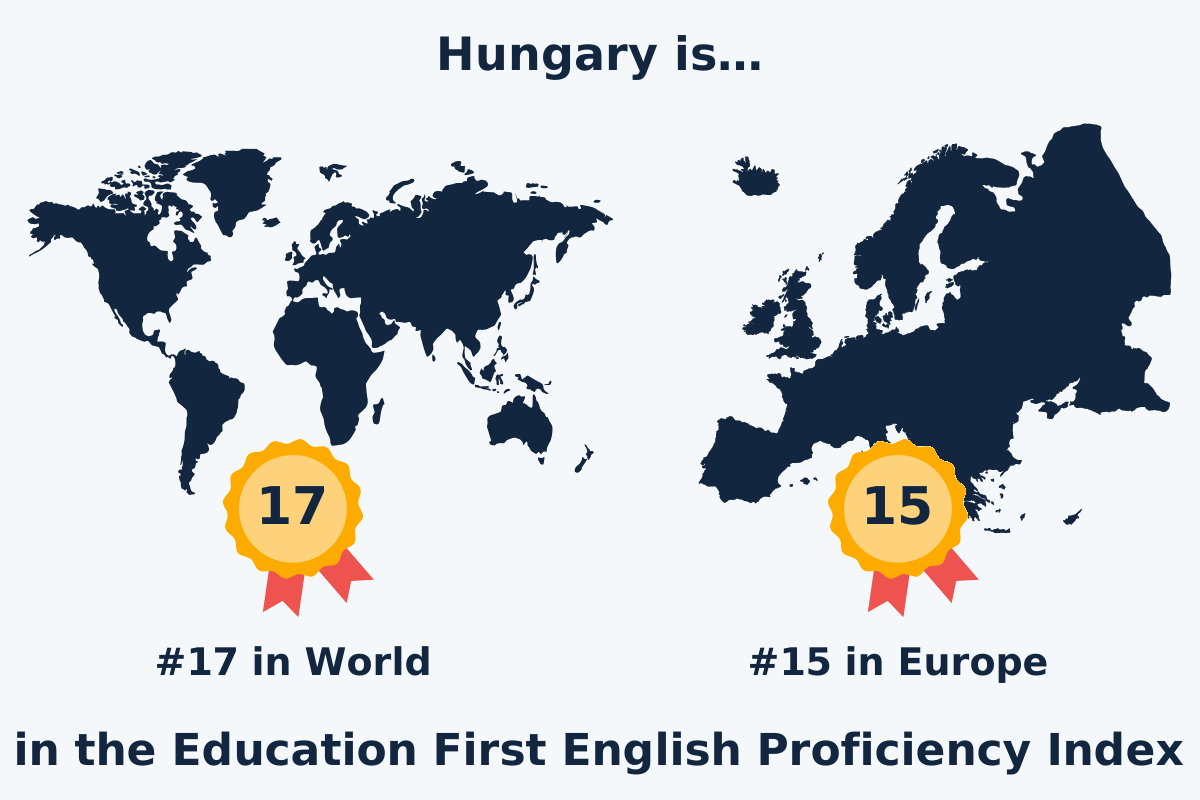
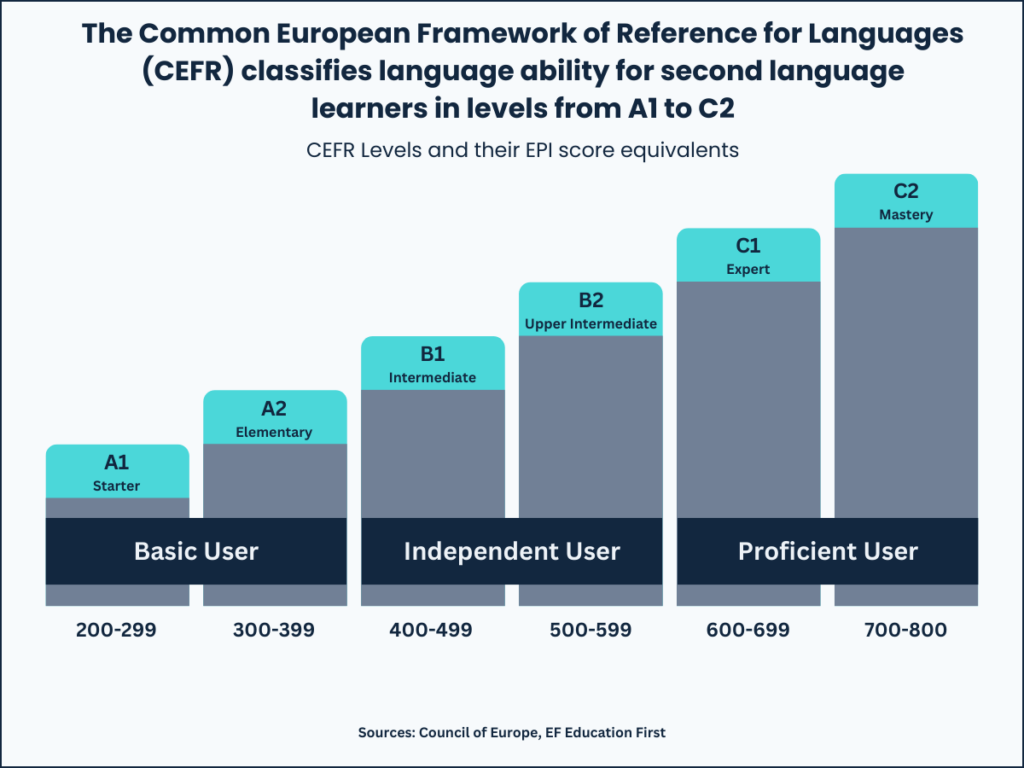
Out of the 9,603,634 people in Hungary, approximately 2,428,295 people can speak English. Or in other words, 25.29% of the population. Furthermore, Hungary ranks impressively high in global English proficiency indexes, with an average English proficiency score of 585, which puts them at a CEFR level of B2, meaning high proficiency.
To put that into context, an English proficiency score of 585 is over 100 points higher than the global average, which comes in at 477 points out of a possible 700.
Source: Autolingual
However, as with any statistic, there’s more to the story. Age, education, region, and even gender all play a role in how widely and confidently English is spoken across the country. Read on to find out more!
You can also find out how many people in Finland speak English!
English Speakers in Hungary (General Stats)
As a country with a complex language all of its own it’s interesting to find out how many people there speak English, how well they speak English and so on. Here are some general stats on the topic.
- Out of the 9,603,634 people in Hungary, approximately 2,428,295 people can speak English. Or in other words, 25.29% of the population.
- Hungary has an English proficiency score of 585 is over 100 points higher than the global average.
- Hungary’s EPI score of 585 puts them in the CEFR B2 category, which means high proficiency.
- Hungary’s EPI score has risen dramatically over the years from 503 points in 2011 up to 585 points in 2024.
- In 2024, the best English speakers in Hungary were between the ages of 26 and 30, consistently achieving very high scores since 2019.
- Hungarian scores in English proficiency for women have been very close to those of men between 2011 and 2024, with rarely more than 20 points between them.
- According to Eurobarometer, 61% of Hungarians think English is the most useful language for their personal development.
- The highest scoring region in 2024 was Central Hungary with 598 points.
- The capital city of Budapest scored 606 points out of 800 in English proficiency, meaning high proficiency.
Sources: Autolingual, EF English Proficiency Index, CEFR, Eurobarometer
Hungary ranks impressively high in global English proficiency indexes, with an average English proficiency score of 585, which puts them at a CEFR level of B2, meaning high proficiency. To put that into context, an English proficiency score of 585 is over 100 points higher than the global average, which comes in at 477 points out of a possible 700.
According to the figures, it’s safe to assume that the average Hungarians over the age of 18 speaks English at a high level, or more specifically, the equivalent of a B2 on the CEFR scale. What this means in real-world terms is that most Hungarians can:
-
Understand the main ideas of complex text on both concrete and abstract topics, including technical discussions in his/her field of specialisation
-
Interact with a degree of fluency and spontaneity that makes regular interaction with native speakers quite possible without strain for either party
-
Produce clear, detailed text on a wide range of subjects and explain a viewpoint on a topical issue giving the advantages and disadvantages of various options.
You can also find out how many people in Spain speak English!
The only official language of Hungary is Hungarian, and it is the first language of some 98.9% of the total population. Unlike other languages spoken in Central and Eastern Europe, Hungarian is not of Germanic, Romanic or Slavic origin. In fact it sounds more like Finnish and Estonian. Interestingly Hungarian is also spoken in the neighboring regions of Romania, Slovakia, Serbia, Ukraine, and Austria.
Hungarian is particularly difficult for English learners because words are formed completely differently, with phrases often combined to form a single word. Basically, instead of using adverbials and prepositions, Hungarian uses suffixes.
Perhaps it’s no surprise then that the only compulsory language in Hungarian schools is Hungarian. However, pupils are often taught a foreign language such as English or German. Approximately 30% of those surveyed in Hungary are able to speak English well enough to be able to have a conversation, making it the most well known language there after Hungarian. This is followed next by German, which has a much lower score on this scale, coming in at just 13%.
Despite this however, the percentage of Hungarians able to carry out a conversation in English is noticeably lower than the average level across the European Union, which comes in at 47%.
According to Education First’s English proficiency index, Hungary’s score has risen dramatically over the years from 503 points in 2011 up to 585 points in 2024. This is consistent with figures from Eurobarometer, which show that the proportion of inhabitants who can hold a conversation in English has gone up by 10% between 2012 and 2023.
You can also find out how many people in India speak English!
Attitudes Toward Learning English in Hungary
When asked “Thinking about languages other than your mother tongue, which two
languages do you think are the most useful for your personal development?” 61% of those surveyed said English. This was followed by German which came in significantly lower at 27%.
When asked the same question but for their children to learn for their future, 84 percent answered English, which is very close to the average response for the whole European Union, which was 85%.
Here, thoughts on the advantages of learning a new language run very close to those of the EU average, centered around being abroad or for economic mobility. Despite this however, 45% of those surveyed said that they have not learned a language recently and don’t intend to start in the coming year.
Source: Eurobarometer
You can also find out how many people in Japan speak English!
English Speakers in Hungary by Region
In all regions of Hungary, English proficiency scores fall between 550 and 600 out of 700, indicating a CEFR level of B2, which means high proficiency.
In 2024, the best performing region was central Hungary, with a score just shy of 600, at 598 points. Meanwhile, the region with the lowest score was the Southern Great Plain, with a score of 583, which is only 15 points lower than the highest performing region.
| Region | EPI Score | CEFR Level | Proficiency |
|---|---|---|---|
| Central | 598 | B2 | High |
| Northern Great Plain | 595 | B2 | High |
| Northern Hungary | 591 | B2 | High |
| Southern Transdanubia | 583 | B2 | High |
| Southern Great Plain | 583 | B2 | High |
Sources: EF English Proficiency Index, CEFR
English Speakers in Hungary by Towns and Cities
Hungary has a total of 3152 localities. This is a term that is not distinguished between cities and towns and the number of villages is 2806. Of these localities, the only one to be included by the survey by Education First was the capital city of Budapest, which has an English proficiency score of 606 points out of 700.
This is a CEFR level of C1, which indicates very high proficiency. People at this level are seen as proficient users, and they:
- Can understand a wide range of demanding, longer texts, and recognise implicit meaning.
- Can express themselves fluently and spontaneously without much obvious searching for expressions.
- Can use language flexibly and effectively for social, academic and professional purposes.
- Can produce clear, well-structured, detailed text on complex subjects, showing controlled use of organisational patterns, connectors and cohesive devices.
Impressive!
Sources: EF English Proficiency Index, CEFR
English Speakers in Hungary by Demographic Group
The best English speakers in Hungary are aged between 26 and 30 years, with an EPI score of 620 in 2024. This is followed by those aged 31 to 40 years, with an EPI score of 598 in 2024, then those aged 21 to 25 years, with an EPI score of 593 in 2024.
Most age groups have seen little change in their English proficiency between 2016 and 2024, especially for those aged 31 to 40, when the score went from 506 in 2016 to 598 by 2024, a points difference of almost 100.
But, whereas English proficiency has improved in age groups 26 to 41 and above, English proficiency has dropped over the years for the age group 18 to 20, having gone from 631 in 2016 to 564 in 2024. Even then however, the English proficiency is still high at the CEFR level of B2, as described earlier.
Hungarian scores in English proficiency for women have been very close to those of men between 2011 and 2024, with rarely more than 20 points between them. In 2011 the women had a higher score than men, but in 2024 it is men who have the higher scores. This “swapping over” occurred between 2021 and 2022.
Sources: EF English Proficiency Index, CEFR
Conclusion
So, just over 2.4 million people in Hungary can hold a conversation in English, giving Hungary an English Proficiency Index score of 585. That puts the country firmly in the “high proficiency” category. Regions like Central Hungary and cities like Budapest boast very high levels of proficiency, while more rural areas still perform well, though slightly lower.
A strong majority of Hungarians see English as the most useful foreign language, both for themselves and their children. It’s also the most widely spoken second language in the country, beating out German by a wide margin, and has grown steadily in popularity over the last decade.
Still, with Hungarian as the only official and compulsory school language, and with only 25% of the population using English regularly, it’s clear that English remains a valuable but secondary language.

Written by Richard Barker
Richard is an English teacher with over 25 years of experience. He has dedicated his life and career to his passion for English, literature, and pedagogy, guiding multiple generations of students on their journey to discovery.