How many people speak English in Austria?
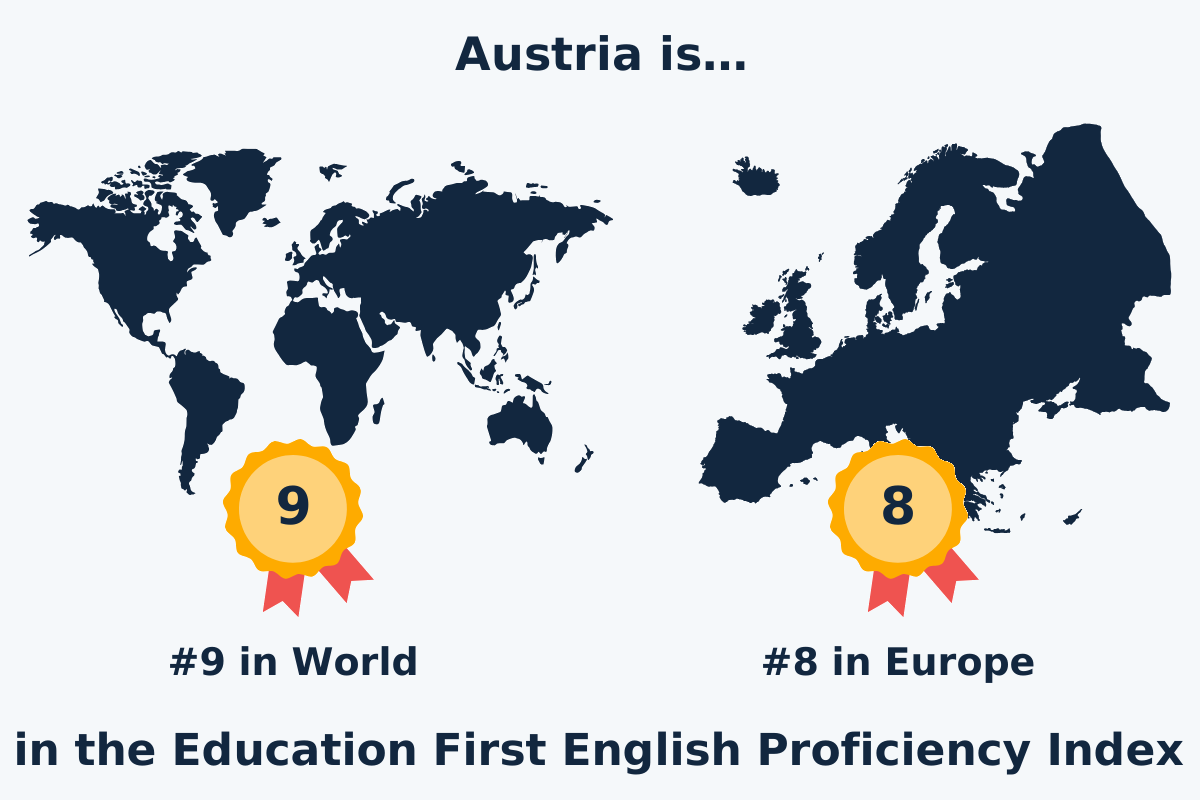
In a continent where English has become the default second language, Austria holds its own. German dominates the linguistic landscape, but English is becoming increasingly important in business, tourism, and education. Austria places a strong emphasis on multilingual education, and English is often at the heart of it. From early schooling to higher education and beyond, English has found a firm footing in Austrian classrooms and professional life.
Out of the 8,415,000 people in Austria, approximately 6,150,000 of them speak English, which works out as an impressive 73%. What’s more, Austria has an outstanding English proficiency score, coming in at 600 out of 700.
To put that into perspective, their score is over 100 points more than the global average score which comes in at 477 points out of 700.
Source: Autolingual
However, as with any statistic, there’s more to the story. Age, education, region, and even gender all play a role in how widely and confidently English is spoken across the country. Read on to find out more!
You can also find out how many people in China speak English!
English Speakers in Austria (General Stats)
Let’s look into this in more detail. Here are a few facts about people speaking English in Austria.
- Out of the 8,415,000 people in , approximately 6,150,000 people can speak English. Or in otheAustriar words, 73% of the population.
- Austria has an English proficiency score of 600 is well over 100 points higher than the global average.
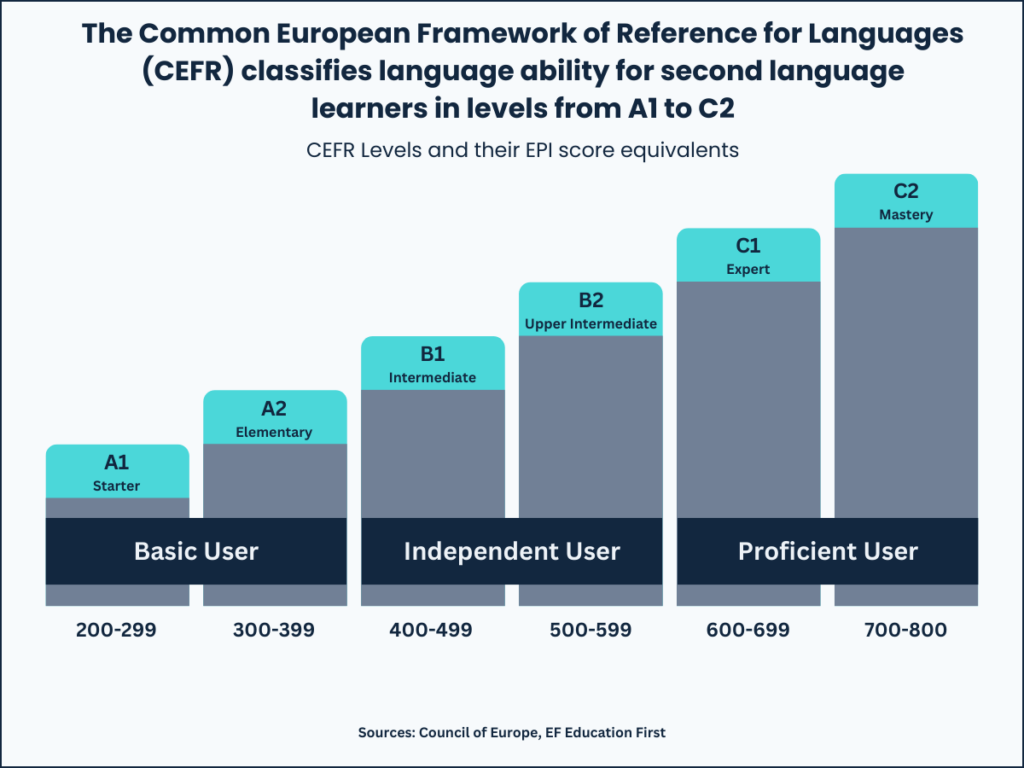
- Austria’s EPI score of 600 puts them in the CEFR C2 category, which means very high proficiency.
- Austria’s EPI score has been up and down over the years, but has consistently maintained a score of over 550 points out of 700 since 2011.
- In 2024, the best English speakers in Austria were between the ages of 21 and 30, achieving EPI scores just short of 650 points out of 700 in 2024.
- Austrian scores in English proficiency for women have been very close to those of men between 2011 and 2024, with rarely more than 30 points between them.
- According to Eurobarometer, 67% of Austrian think English is the most useful language for their personal development.
- The highest scoring region for English proficiency in 2024 was Salzburg with 609 points.
- The capital city of Vienna had 628 points out of 800 in English proficiency in 2024, meaning very high proficiency.
Sources: Autolingual, EF English Proficiency Index, CEFR, Eurobarometer
Austria ranks impressively high in global English proficiency indexes, with an average English proficiency score of 600, which puts them at a CEFR level of C1, meaning high proficiency. To put that into context, an English proficiency score of 600 is over 100 points higher than the global average, which comes in at 477 points out of a possible 700.
According to the figures, it’s safe to assume that the average Austrians over the age of 18 speaks English at a high level, or more specifically, the equivalent of a C1 level on the CEFR scale. What this means in real-world terms is that most Hungarians:
- Can understand a wide range of demanding, longer texts, and recognise implicit meaning.
- Can express themselves fluently and spontaneously without much obvious searching for expressions.
- Can use language flexibly and effectively for social, academic and professional purposes.
- Can produce clear, well-structured, detailed text on complex subjects, showing controlled use of organisational patterns, connectors and cohesive devices.
You can also find out how many people in Japan speak English!
The only official language in Austria is German, and 84% of inhabitants consider German to be their mother tongue. Nine years of education are mandatory in Austrian schools, where a modern foreign language, usually English, is introduced in primary school and continues into lower secondary education.
The average score for English proficiency in Austria has been really up and down over the years. For instance, in 2011 they reached a score of 566, which is a B2 level on the CEFR scale, meaning high proficiency. However, by the year 2021, their score had gone up by over 100 points to the height of 641 points out of 700, which is almost at a C2 level on the CEFR scale, meaning very high proficiency.
You can also find out how many people in India speak English!
Attitudes Toward Learning English in Austria
When asked “Thinking about languages other than your mother tongue, which two
languages do you think are the most useful for your personal development?” 67% of those surveyed said English. This was followed by French which came in substantially lower at a mere 11%
When asked the same question but for their children to learn for their future, 79 percent answered English, which is very close to the average response for the whole European Union, which was 85%.
Here, thoughts on the advantages of learning a new language run very close to those of the EU average, centered around being abroad or for economic mobility. Despite this however, 45% of those surveyed said that they have not learned a language recently and don’t intend to start in the coming year.
Source: Eurobarometer
You can also find out how many people in the Philippines speak English!
English Speakers in Austria by Region
No matter where you go in Austria, you will typically find high or very high levels of English proficiency. The highest score comes from Salzburg, reaching 609 points out of 700, which is C1 on the CEFR scale, which means very high proficiency, as described earlier.
The lowest performing region was Vorarlberg, with a score of 556, which is little more than 50 points less than the top performing region, and is still a high level of proficiency, at B2 on the CEFR scale.
Here is a breakdown for ease of reference.
| Region | EPI Score | CEFR Level | Proficiency |
|---|---|---|---|
| Salzburg | 609 | C1 | Very High |
| Oberösterreich | 600 | C1 | Very High |
| Niederösterreich | 597 | B2 | High |
| Burgenland | 597 | B2 | High |
| Steiermark | 596 | B2 | High |
| Tirol | 587 | B2 | High |
| Kärnten | 569 | B2 | High |
| Vorarlberg | 556 | B2 | High |
Sources: EF English Proficiency Index, CEFR
English Speakers in Austria by City
In 2024, there were three Austrian cities that were surveyed by Education First to discover their English proficiency. All of which scored very high, each at a CEFR level of C1, meaning very high proficiency.
The highest scoring city was Graz, which had a very impressive score of 643 points out of 700. Scoring lowest was Salzburg, which still had a very high score, coming in at 613 points out of 700.
The capital city of Vienna was in the middle, with the very high score of 628 points out of 700.
Here is a breakdown for ease of reference.
| City | EPI Score | CEFR Level | Proficiency |
|---|---|---|---|
| Graz | 643 | C1 | Very High |
| Vienna | 628 | C1 | Very High |
| Salzburg | 613 | C1 | Very High |
Sources: EF English Proficiency Index, CEFR
English Speakers in Austria by Demographic Group
In 2024, the best English speakers in Austria were between the ages of 21 and 30, achieving EPI scores just short of 650 points out of 700 in 2024. This is followed by those aged 31 to 40 years, then those aged 18 to years, and finally those aged 41 and over, with a score that still indicates high proficiency at 579 points out of 700.
While English proficiency has improved over the years for most age groups, those aged 18 to 20 years have seen a decline of approximately 100 points.
Austrian scores in English proficiency for women have been very close to those of men between 2011 and 2024, with rarely more than 30 points between them. Women were outperforming men in 2015, with scores of 612 and 584 points respectively, but by 2024 this had reversed, with scores of 590 and 611 respectively.
Sources: EF English Proficiency Index, CEFR
Conclusion
With over 73% of Austrians able to speak English, it’s safe to say that Austria ranks as one of Europe’s most proficient non-English-speaking countries. Its EPI score of 600, which comfortably places the country in the “very high proficiency” category (C1 on the CEFR scale), tells us that English is more than just a foreign language in Austria—it’s a key part of education, international communication, and everyday life in many regions and cities.
This is especially evident in places like Vienna, Graz, and Salzburg, where city-wide English proficiency scores remain consistently strong. Likewise, the region of Salzburg leads the national average, though even the lowest-scoring region, Vorarlberg, still falls within the “high” proficiency bracket.
What’s perhaps most notable is how positively Austrians view English. More than two-thirds see it as the most useful language for personal development, and an even higher percentage want their children to learn it. In a world where English continues to open doors, Austria is clearly keeping those doors wide open.

Written by Richard Barker
Richard is an English teacher with over 25 years of experience. He has dedicated his life and career to his passion for English, literature, and pedagogy, guiding multiple generations of students on their journey to discovery.