How Many People in Italy Speak English?
English is the most common foreign language taught in European schools, as well as the most widely spoken second language in the European Union. That said, the number of English speakers can vary drastically from one country to another. In general, English speakers are less common in Southern Europe, compared to Northwestern Europe.
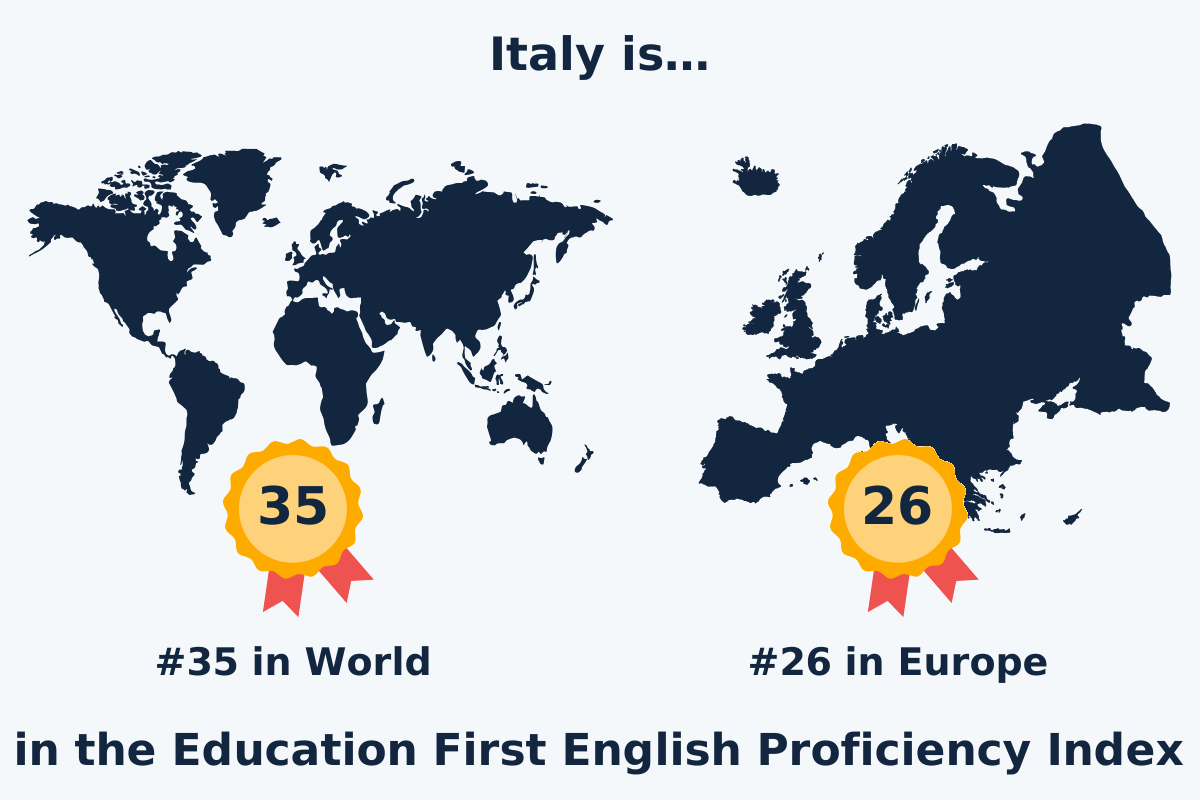
Italy is no exception to this pattern. The majority of Italians don’t know much English, according to recent surveys. Just around a third of Italians speak English in any capacity. The English Proficiency Index ranks Italy 32nd out of 34 countries in Europe for English skills. Overall, the level of English in Italy is moderate and similar to that in France and Spain.
Although less of Italy’s population speaks English compared to other European nations, certain parts of the country have a decently-sized English speaking population. For example, many Italians in the northern regions and cities of Italy know English. Similarly, certain parts of the country also have high or very high English proficiency on average.
Keep reading to discover more interesting facts about English in Italy! This article covers the latest statistics about English speakers in Italy.
What Percentage of People in Italy Speak English?
English is not widely spoken in Italy. Only around 29-34% of people in Italy know English, according to the latest data from the Italian National Institute of Statistics and the European Commission. Overall, both sources suggest that around a third of Italians have some knowledge of the English language.
The E.U. Eurobarometer report on Italy was published in 2012 and was based on 1,036 interviews. Here are some of the results:
- 38% of Italian people aged 15 and older speak at least one foreign language, English being the most popular choice.
- 34% of Italians claim they are able to speak English well enough to have a conversation.
- Roughly 35% of those who know at least one foreign language have the listening, reading, and writing skills necessary to follow the news on radio or TV, read newspapers or magazines, and communicate online in the target language.
The national ISTAT survey was conducted in 2015 and had a sample size of 24,000 families distributed throughout 850 Italian municipalities. This later survey found that:
- Most Italians speak Italian as well as a second language. 60% of Italians aged 6 and up spoke at least one foreign language, and 48% of those spoke English.
- Overall, 29% of the Italian population speaks English as a foreign language, though English proficiency within this group varies.
- Only 7% of all English speakers in Italy claimed to have excellent language skills overall.
- 27% of English speakers in Italy claim to have good language skills, while 28% claim their English knowledge is just satisfactory.
- More Italians are confident in their reading and listening skills compared to their speaking ability. Roughly 37% and 31% of English speakers claim to have excellent reading and listening skills, respectively.
It should be mentioned that the data in these surveys is self-reported, and people’s self-assessment of language skills isn’t always accurate. But, based on these numbers, it seems like 1 in 3 Italians have English skills equivalent to a CEFR level of B1 (intermediate) or higher. Very few people claim to have advanced English knowledge (a CEFR level of C1-C2).
The number of Italians who know at least some English (a CEFR level of A1-A2) is likely higher. People at this language level can recognize and use basic English words and phrases to introduce themselves and communicate simple information on basic topics (travel, shopping, family, hobbies, etc.). However, people in this category wouldn’t be classified as fluent speakers, as they can’t hold a conversation in English.
Sources: Eurobarometer, Istituto Nazionale di Statistica
We also have the figures for several other countries, including Finland, Norway, Taiwan and The Philippines.
Number of English Speakers in Italy (General Stats)
Surveys from Italy and the European Commission show that there isn’t much English spoken in Italy. However, English is increasingly more common in certain parts of the country and among certain demographic groups. So, let’s take a closer look at the foreign language trends in the country:
-
More than 34 million Italians speak at least one foreign language, primarily English, French, or Spanish.
-
Fewer people in Italy speak English, compared to the EU average. However, Italians are also more likely to learn French and Spanish, compared to those in other European countries.
-
Approximately 19 million people in Italy speak English as a second language.
-
Roughly 1.3 million people in Italy are highly proficient in English, while most English speakers rate their skills as either good or average.
-
Most Italians are in favor of English education— 70% of Italian survey respondents think English is the most useful language for personal development, and 84% believe it’s the most important foreign language for children to learn.
6. All Italian students learn English in school. As per the Italian school curriculum, English is a mandatory subject for all children starting in first grade (roughly at the age of 6).
- The prevalence of English is increasing. Between 2006 and 2015, there was a 26% growth in the share of Italians who claim to have good English skills.
During the same period, there was a 14% increase in the category of English speakers with excellent language skills. Beyond these numbers, there are also many more Italians who speak at least some English.
-
In the 2024 edition of the English Proficiency Index, Italy ranked #32 in Europe, and #46 in the world for overall English skills.
-
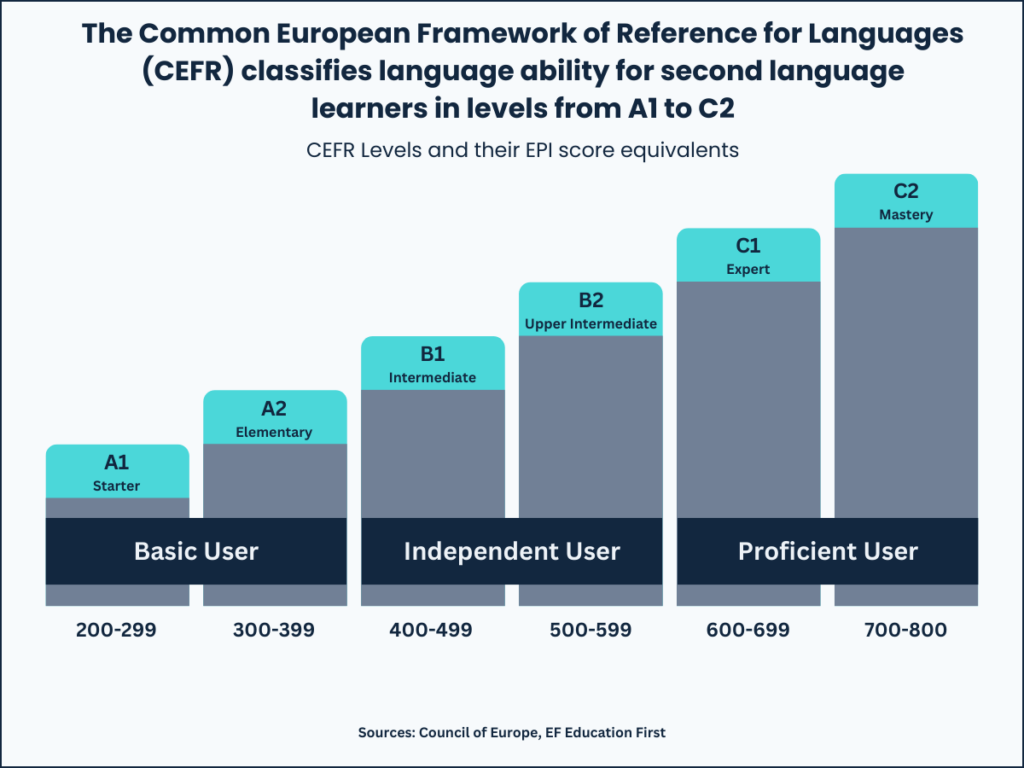
Since 2014, Italy’s proficiency score has consistently ranged between 500 and 550 points, indicating moderate English skills equivalent to a CEFR level of B2.
10. The English proficiency in cities like Verona, Bari and Bologna, is high at B2 level.
11. There’s a clear English gap between Northern and Southern Italy. People in northern and central regions are the most likely to have excellent language skills, while Italians in the south are the most likely to report poor knowledge of English.
12. English knowledge is also more common among Italians under 35 years old and among those with a higher level of education.
English might not be that widespread in Italy, but it’s certainly gaining traction. Italy has made real progress since the launching of the English Proficiency Index in 2011, going from low to moderate English skills over the past decade.
Sources: Eurobarometer, Istituto Nazionale di Statistica, Education First, Western Libraries
Where In Italy Is English Widely Spoken?
The proportion of English speakers in the country is rather low. But English is not spoken to the same extent in Italy as a whole. Some parts of Italy have a decent amount of English speakers.
This is true about big cities, especially in Northern and Central Italy, where a little over 50% of people speak English. Some of the places with the most (and best) English speakers in Italy include:
- Bologna
- Milan
- Turin
- Venice
- Florence
- Rome
Besides having lots of English speakers overall, Northern and Central Italian cities and regions also have the largest percentage of fluent speakers— over 35% of survey respondents claim good or excellent language skills. This doesn’t include those with a moderate level of English.
English speakers are less common outside of metropolitan areas, as well as in Southern Italy and the islands. Less than 30% of respondents in the south claimed to have good or great language skills in 2015.
At the same time, over 30% of people in the regions of Sardinia, Campania, Sicily, Calabria, and Marche reported poor knowledge of the English language. The difference in English speakers across Italian regions is also reflected in proficiency scores, with Southern and Insular regions ranking lower in 2023.
A large part of this discrepancy has to do with education and economic opportunities. The highly developed regions in the Northern and Central parts of the country attract the most investments, and have a higher standard of living than other parts of Italy.
University students and graduates looking for better jobs are likely to emigrate to the north and center. This part of Italy is also home to many international companies and a booming tourism industry, so the demand for a multilingual workforce is also higher.
However, when comparing large cities in the North and South among each other, the English proficiency is similar. Major cities in the South and the islands, like Palermo, Cagliari, and Bari scored similarly to Venice, Milan, Rome, or Pisa in North and Central Italy.
Sources: Istituto Nazionale di Statistica, Education First, Nature Italy
English Speakers in Italy by Region
Italy is divided into 20 administrative regions. In the 2023 edition of the English Proficiency Index, Italian regions were nearly equally divided into “moderate” and “high” English proficiency, with all Northern regions having above-average scores.
The best English-speaking regions in Italy are:
- Friuli-Venezia Giulia
- Emilia-Romagna
- Trentino-Alto Adige
- Veneto
- Piedmont & Aosta Valley
Here’s a full list of regional proficiency scores and their approximate CEFR level:
| Region | EPI Score | Proficiency Level | CEFR Level |
|---|---|---|---|
| Friuli-Venezia Giulia | 581 | High | B2 (Upper-intermediate) |
| Emilia-Romagna | 560 | High | B2 (Upper-intermediate) |
| Trentino-Alto Adige | 559 | High | B2 (Upper-intermediate) |
| Veneto | 558 | High | B2 (Upper-intermediate) |
| Piedmont & Aosta Valley | 552 | High | B2 (Upper-intermediate) |
| Liguria | 543 | Moderate | B2 (Upper-intermediate) |
| Lombardia | 540 | Moderate | B2 (Upper-intermediate) |
| Marche | 540 | Moderate | B2 (Upper-intermediate) |
| Umbria | 539 | Moderate | B2 (Upper-intermediate) |
| Toscana | 535 | Moderate | B2 (Upper-intermediate) |
| Lazio | 529 | Moderate | B2 (Upper-intermediate) |
| Campania | 527 | Moderate | B2 (Upper-intermediate) |
| Sicilia | 524 | Moderate | B2 (Upper-intermediate) |
| Puglia | 520 | Moderate | B2 (Upper-intermediate) |
| Sardegna | 515 | Moderate | B2 (Upper-intermediate) |
| Basilicata | 513 | Moderate | B2 (Upper-intermediate) |
| Abruzzo | 512 | Moderate | B2 (Upper-intermediate) |
| Calabria | 511 | Moderate | B2 (Upper-intermediate) |
Calabria had the lowest score overall in 2024. According to the Education First study report, proficiency scores between 500-599 points fall within the B2 CEFR level.
On average, English speakers across all Italian regions have the language skills necessary to:
- Understand the main ideas communicated in a range of regular and complex texts in written and spoken English
- Speak with reasonable speed and accuracy, being able to carry a regular conversation with a native English speaker
- Write clear and detailed texts on a variety of subjects, expressing and supporting one’s viewpoint on a given topic
Though not that many Italians speak English, especially in the southern regions of Italy, there are still a lot of people who are fluent. Of course, these results aren’t guaranteed to be representative. The English Proficiency Index test is a free online resource accessible to everyone.
Those who are the most interested in improving their English skills are more likely to test their knowledge. Still, the proficiency scores in different Italian regions mirror the same trends observed in national surveys. More Northern Italians tend to speak English, and the level of English proficiency is higher.
Sources: Education First 1, 2, & 3
English Speakers in Italy by City
Almost all major cities in Italy have good English skills, according to average proficiency scores. The most English-friendly cities in 2024 were:
- Verona
- Bari
The average English proficiency in these Northern Italian cities is high to moderate, equivalent to a CEFR level of B2. You can check out the full list below:
| City | EPI Score | Proficiency Level | CEFR Level |
|---|---|---|---|
| Verona | 580 | High | B2 (Upper-intermediate) |
| Bari | 577 | High | B2 (Upper-intermediate) |
| Bologna | 572 | High | B2 (Upper-intermediate) |
| Turin | 571 | High | B2 (Upper-intermediate) |
| Milan | 570 | High | B2 (Upper-intermediate) |
| Palermo | 566 | High | B2 (Upper-intermediate) |
| Venice | 562 | High | B2 (Upper-intermediate) |
| Cagliari | 558 | High | B2 (Upper-intermediate) |
| Rome | 548 | Moderate | B2 (Upper-intermediate) |
| Florence | 547 | Moderate | B2 (Upper-intermediate) |
| Naples | 547 | Moderate | B2 (Upper-intermediate) |
| Catania | 535 | Moderate | B2 (Upper-intermediate) |
Large cities in Southern and insular Italy also have higher proficiency than the rest of the surrounding region.
It’s also worth mentioning that, in real terms, the difference between “moderate”, and “high”proficiency is not drastic enough to impede people’s ability to communicate effectively in English.
Sources: Education First
English Speakers in Italy by Demographic Group
Younger people in Italy are more likely to speak English, although proficiency is improving across all age groups. Let’s take a closer look at English language trends across demographic groups:
- Slightly more men than women speak English in Italy. However, both men and women who speak English have moderate proficiency on average.
- Italians under 35 years old are the most likely to speak English.
- Between 2006-2015, the share of Italians under 25 years old speaking English remained the same— roughly 60%. During the same time, there was an increase in English speakers in all other age groups.
- The percentage of Italians aged 25-34 years old who spoke English climbed up from 49% to 57% within the same time frame.
- A similar increase was observed in the 35-44 age group, which went from 36% to 44%. Among those aged 45-54 years old, the share of people who spoke English went from 22% to 29%. In Italians aged 65+ years old, the share of English speakers nearly doubled within the same period, going from roughly 2% to approximately 4%.
- People in Northern Italy were more likely to have good or excellent English skills compared to other parts of the country.
- In 2024, Italians aged 21-40 years old had high English proficiency on average. Among those, Italians aged 26-30 had the highest EPI score at 572 points.
- Those aged 41+ years old had the most drastic improvement in English skills over the years, going from very low proficiency in 2015 to moderate proficiency in 2020-2024. In the 31-40 years old age group, proficiency went from low to high within the same period.
- In Italians aged 21-25, English proficiency scores have been mostly stable within the moderate to high band.
- Since 2020, Italians aged 18-20 years old were the only age group to see a drop in proficiency scores. According to the EF report, this is likely a result of the COVID-19 pandemic and its impact on the education system.
- Those with a higher education are more likely to have great language skills. Among adults aged 25+ years old, nearly 48% of graduates reported either good or excellent speaking skills, compared to 28% of those with a high school diploma.
Overall, more people under 25 know English than any other age group but the majority of Italians under 35 speak English. Those aged 26-30 have the best language skills overall, according to proficiency data.
Great English skills are also more common among those with a higher education. According to the latest Italian survey, the most common method for learning foreign languages is through school or university courses, especially among Italians under 25 years old.
The most common methods of learning a foreign language for those aged 25+ are private lessons, followed by studying or working abroad and going on holidays to other countries. These learning methods were more common in Italy’s northern population, which also explains part of the difference in English language proficiency among Italian regions.
Sources: Istituto Nazionale di Statistica, Education First
Conclusion
English is not common across all of Italy but there are huge differences among age groups. Overall, only a third of all Italians know English, but the number of speakers is a lot higher in young adults. Over half of Italians under 35 years old speak English, and this age group also has the highest proficiency on average.
Fluent English speakers of all ages are also more common in Northern regions and most of the large metropolitan areas in Italy. Cities like Verona and Milan, have high English proficiency and a good number of people with good or excellent English speaking skills.
FAQs
1. What are the languages spoken in Italy?
Multiple languages are spoken in Italy. The official language of Italy is Italian, which is spoken as a mother tongue by the vast majority of the population. Italy also has multiple officially recognized minority languages, most of which are of either Latin or Germanic origin. Examples of minority languages in Italy include Cimbrian, Occitan, Sardinian, and Catalan.
Most Italians also study foreign languages in school. English is the most commonly learned foreign language in Italy and the most widely spoken language besides Italian. Other commonly studied second languages include French, Spanish, and German. Most of the bilingual people in Italy speak Italian and English.
2. Is it impolite to speak English when you visit Italy?
It’s definitely not impolite to speak English, especially if you’re traveling to Italy as a tourist. Nobody expects foreigners to know Italian just for a trip to Italy. It’s quite easy to find English speakers in larger cities and tourist locations.
That said, not all Italians know English or are comfortable speaking the language. It’s considered good etiquette to first ask people whether they speak English. A simple “Mi scusi, lei parla inglese?” will suffice.
Knowing a few basic Italian phrases also goes a long way, especially if you’re afraid you’ll encounter a language barrier. Most Italians under 35 speak some English, but even people who aren’t fluent are usually willing to help tourists with directions. Those visiting can easily get by in Italy without speaking Italian. However, moving to Italy is a different matter. If you plan to live in Italy, you will have to learn Italian.
3. Is English language media popular in Italy?
Italians certainly enjoy American media. English-language music is very popular, and foreign songs frequently top the music charts alongside local Italian tunes. American and British movies and series are also very popular, just not the English version.
Although Italians enjoy foreign cinema, many English movies are dubbed in Italian, since most of the people still prefer watching movies with Italian language dubbing, rather than subtitles. In the EU, Italians are also less likely to prefer subtitled movies, compared to the European average.

Written by Diana Ploscaru
Diana is a trilingual ESL teacher and writer with a M.A. in Translation and Terminology. She has spent over 10 years studying English, German, and philology, and now wants to share her knowledge and passion with other linguistics enthusiasts.