How Many People in Portugal Speak English?
There’s a common idea that fewer people speak English in Southern European countries, and English proficiency is considerably lower, especially compared to that of Northwestern countries in Europe. So, how true is this about Portugal?
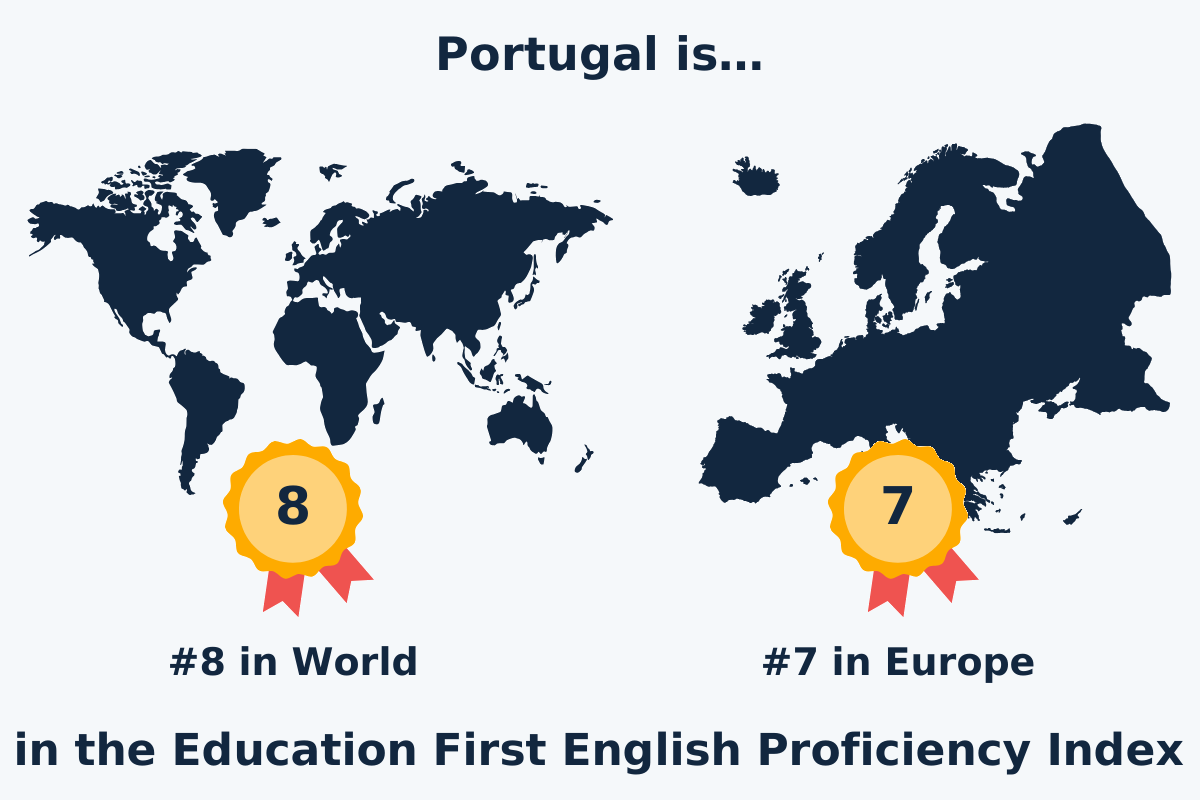
According to the most recent data, most Portuguese people don’t speak English. Recent surveys place the number of English speakers at roughly 1 in 4. It’s not that common to hear English spoken in Portugal, compared to other countries in Europe. However, the EF English Proficiency Index ranks Portugal among the best English-speaking countries in the world.
In 2024, Portugal ranked 6th globally, and 5th in the European Union, beating neighboring Spain, as well as Germany and Luxembourg. In other words, fewer people speak English in Portugal, compared to other European countries, but a considerable number of Portuguese people still speak good English.
So, why so few English speakers? Roughly 40% of Portugal’s total population can speak at least one foreign language. But these speakers are divided among English, French, and Spanish. Overall, fewer people in Portugal speak English, compared to the EU average. At the same time, Portugal has more French and Spanish speakers.
However, more and more Portuguese people are switching from French to English, as opinion surveys and proficiency data show. Keep reading to learn more about Portugal’s fascinating English language trends!
What Percentage of People in Portugal Speak English?
According to the 2012 Eurobarometer report, less than a third of Portuguese people speak English, a smaller percentage compared to the EU average. Let’s take a closer look at the survey findings:
- 27% of people in Portugal speak English well enough to carry a conversation (compared to the 38% EU average).
- The number of people who understand more complex written or spoken English is likely lower than the 27% who have a conversational English level.
- For example, nearly 40% of Portuguese people speak at least one foreign language at a conversational level, but 36% of Portuguese people know at least one foreign language well enough to follow the news on radio or TV and 32% can read a newspaper or magazine article.
- 53% of survey respondents think the English language is useful for their self-development (vs 67% EU average).
- 87% of Portuguese people believe learning English is useful for a child’s future (vs 79% EU average).
The Eurobarometer report included survey respondents aged 15 and up. A subsequent 2017 study published by the INE (Instituto Nacional de Estatística), which only included adult respondents (ages 18-69), showed that over 70% spoke one foreign language. Roughly 43% of Portuguese adults under 70 spoke English, according to the same data.
Portugal has fewer English speakers than other European countries, but also more people who speak French. In fact, more people in Portugal speak French and believe French is a useful language, compared to the EU average.
There’s a clear age gap among foreign language speakers in Portugal. The same 2012 European study shows that more of the younger people know a foreign language and more of them speak English compared to older generations:
- 26% of Portuguese aged 15-34 speak English, and an additional 24% speak other foreign languages (mainly French or Spanish).
- 12% of people aged 35-54 speak English. This age group also has a more even split among English, French, and Spanish speakers.
- Less than 4% of Portuguese people aged 55+ speak English. Only 15% of this age group speaks any foreign language, mainly French.
English is spoken mostly by people under the age of 35. English and French are competing as the first foreign language of choice, with the younger generation shifting towards English. Most teenagers now learn English as their main foreign language. Keep in mind these 2012 figures have likely changed within the past decade.
The percentage of English speakers over 35 years old has likely increased since the last Eurobarometer survey, as more previously young adults entered this age group in the past few years. According to English proficiency data, Portuguese people aged 31-41+ had the highest increase in proficiency scores in 2018.
Sources: Eurobarometer, INE, Languageknowledge.eu, Education First
Number of English Speakers in Portugal (General Stats)
The latest and most reliable data about Portugal’s English-speaking population dates back to 2012, though more recent data about English proficiency is also available. Let’s take a closer look at how English is spoken in Portugal:
-
Based on the most recent estimates, around 2.8 million people in Portugal speak English as a second language.
-
Portuguese people under 35 are the most likely to speak English.
-
The vast majority of Portuguese people over 55 years old don’t speak English at all.
-
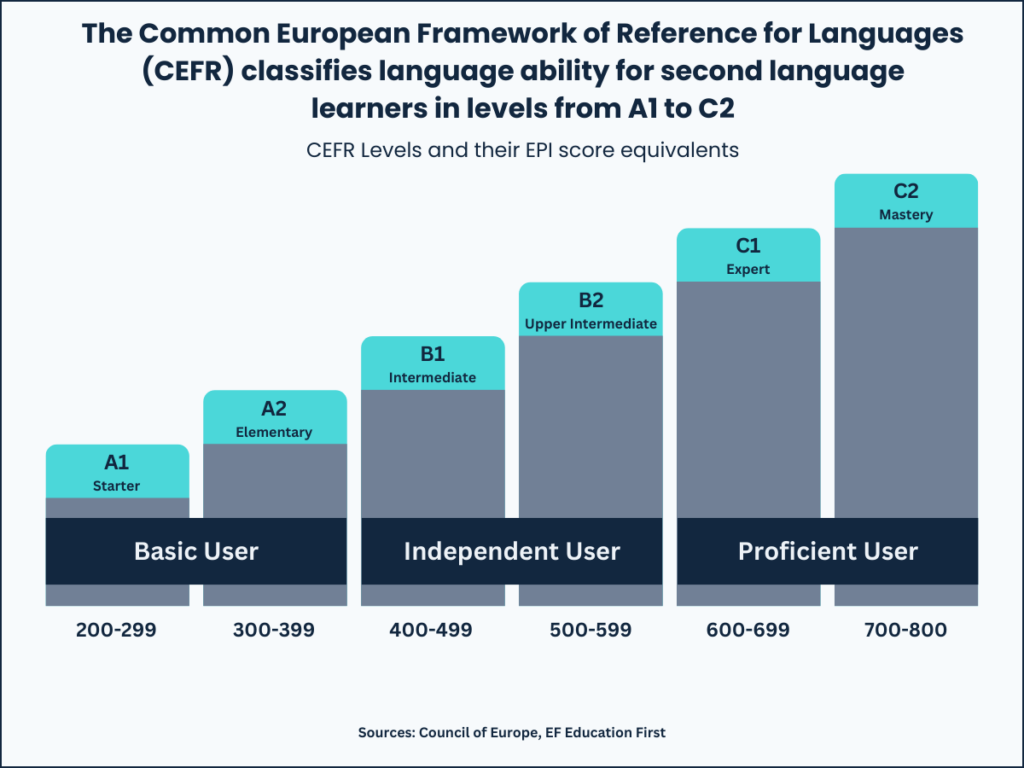
When it comes to speaking English, the average proficiency level among speakers in Portugal is very high, equivalent to a C1 CEFR level.
-
Portugal ranked 5th in Europe for English proficiency in 2024, with an English proficiency score of 605 points. This score puts Portugal’s English proficiency next to countries like Denmark and Sweden.
-
Portugal is among the countries with the fastest increase in English proficiency. In 2012, Portugal had moderate proficiency, and a score comparable to Chile’s today, which ranks #52 worldwide. Since 2019, Portugal has joined the proficiency ranks of Germany, the Netherlands, and the Nordic countries.
-
Portuguese people aged 21-30 have the best English skills, with scores above the national average.
-
People in Coimbra have the best English skills on average. In 2023, the English proficiency in this Portuguese city is similar to that in other big European cities like Copenhagen, Stockholm, or Cologne.
-
All school-aged Portuguese children study two foreign languages. Since the 80s, English has been taught in schools as a compulsory school subject starting in grade 5 (age 10). Since 2012, English is the mandatory L1, with French, Spanish, or German being the main L2 options.
10. Since 2005, extra-curricular English classes have also become increasingly popular for children ages 6 and up.
In 2012, Portugal had a smaller English-speaking population compared to other European countries, and the average proficiency level was moderate to low. However, over the past few years, Portugal has become one of the top 10 best English-speaking countries in Europe (and the world).
Likely, the actual number of English speakers in Portugal is now higher than 2012 statistics suggest, especially among those aged 18-40. Changes in the foreign language curriculum in Portugal could explain part of the positive English proficiency trend over the past decade.
Despite the historical popularity of French and Spanish, English is now the foreign language of choice for most learners. Nearly three times as many Portuguese people believe English is important for children to learn, compared to French. Similarly, over twice as many people see English as important for personal development.
Sources: Eurobarometer, Languageknowledge.eu, Education First, ResearchGate
We have the figures for other European countries besides, including France, Spain, Germany, and Sweden.
Where In Portugal Is English Widely Spoken?
Portugal has fewer English speakers than other European countries. That said, English is widely spoken in certain parts of the country, especially:
- Northern Portugal
- Central Portugal
- Lisbon metropolitan area
Besides having the most English speakers on average, they also stand out for their very high proficiency. These Portuguese regions have the largest population overall and contribute the most to the country’s GDP.
Northern and Central Portugal and the Lisbon metro area also have the highest upper education attendance, with most students pursuing business management, engineering, and health-related degrees, where English knowledge is of growing importance.
These three regions are also home to over 80% of all non-financial companies in Portugal, having well-developed manufacturing, production, and export industries. English is in high demand in the local job market, especially in large cities with a growing number of big international companies.
English is also more common in Portugal’s most popular tourist areas. The regions and cities with the most international traffic, where English is a necessity in tourism and accommodations, include:
- Lisbon
- Algarve
- Porto
- Madeira
- Alentejo
- The Azores
Lisbon and Algarve attract the most tourists and expats by far. The Algarve, in particular, is the most popular tourist destination for visitors from the United Kingdom. In 2022, nearly half of all British tourists in Portugal chose Algarve as their vacation destination.
These destinations are also home to many expats living in Portugal, most of them British. According to 2018 figures, 24% of expats living in Portugal at the time were British citizens.
Sources: AICEP Portugal Global, Education First, Statista 1 & 2
English Speakers in Portugal by Region
According to proficiency data, all of Portugal’s surveyed districts have either high or very high English scores. The districts with the best English skills in 2023 were:
- Braga
- Viseu
- Coimbra
- Aveiro
A few more districts also had proficiency scores above or close to the national average. Here’s the full list:
| Region / District | EPI Score | Proficiency Level | CEFR Level |
|---|---|---|---|
| Braga | 634 | Very High | C1 (Advanced) |
| Viseu | 627 | Very High | C1 (Advanced) |
| Coimbra | 627 | Very High | C1 (Advanced) |
| Aveiro | 621 | Very High | C1 (Advanced) |
| Évora | 617 | Very High | C1 (Advanced) |
| Lisboa (Lisbon) | 615 | Very High | C1 (Advanced) |
| Madeira | 615 | Very High | C1 (Advanced) |
| Porto | 614 | Very High | C1 (Advanced) |
| Setúbal | 605 | Very High | C1 (Advanced) |
| Leiria | 603 | Very High | C1 (Advanced) |
| Castelo Branco | 603 | Very High | C1 (Advanced) |
| Faro | 601 | Very High | C1 (Advanced) |
| Santarém | 590 | High | B2 (Upper-Intermediate) |
| Viana do Castelo | 575 | High | B2 (Upper-Intermediate) |
| Bragança | 548 | Moderate | B2 (Upper-Intermediate) |
There was a 86-point difference between the top and bottom-ranking districts in 2024. However, the average English speaker in each district is likely to speak great English.
Those with an upper-intermediate English level still have the listening, reading, and speaking skills necessary to understand English and communicate effectively in most everyday situations.
Sources: Education First
English Speakers in Portugal by City
As a general rule, people in large Portuguese cities are the most likely to speak English, especially the younger generation. The largest municipalities, and especially the district capitals, have the most fluent English speakers.
In 2024, some of the cities with the best English were:
- Braga
- Coimbra
- Lisbon
- Aveiro
The latest edition of the English Proficiency Index only includes proficiency scores for eight of Portugal’s largest cities. Here’s how these cities compare:
| City | EPI Score | Proficiency Level | CEFR Level |
|---|---|---|---|
| Braga | 636 | Very High | C1 (Advanced) |
| Coimbra | 631 | Very High | C1 (Advanced) |
| Lisbon | 626 | Very High | C1 (Advanced) |
| Aveiro | 625 | Very High | C1 (Advanced) |
| Porto | 618 | Very High | C1 (Advanced) |
| Setúbal | 599 | High | B2 (Upper-Intermediate) |
| Leiria | 595 | High | B2 (Upper-Intermediate) |
Judging by the high proficiency scores for Portugal’s regional districts, it’s likely that other major cities like Angra do Heroísmo, Castelo Branco, Funchal, and Faro also have good English skills on average.
Unfortunately, the English Proficiency Index provides proficiency scores only for the regions and cities with at least 400 test takers. In 2024, only a limited number of cities in Portugal had enough test takers, though most districts did make the cutoff point. In most parts of Portugal, the people who speak English have a B2 or C1 level on average.
Sources: Education First
English Speakers in Portugal by Demographic Group
Based on what the data shows, there’s a clear age gap when it comes to English in Portugal. Older adults are the least likely to speak a foreign language but also tend to favor French more.
Young adults and teenagers are the most likely to speak English, and they have the best proficiency scores on average. Let’s take a closer look at who speaks the best English in Portugal:
- Portuguese people in their 20s are the first generation to have had wide access to early extracurricular English courses in schools, starting at age 6. However, adults under 50 have all received compulsory English education in grades 5 through 9.
- 26% of Portuguese people aged 15-34 speak English, compared to 12.48% of those aged 35-54. Just 3.47% of people aged 55+ know English.
- English proficiency scores are highest in those aged 21-30.
- Since 2018, English proficiency rose among both men and women. Men’s scores remained stable between 2020-2024, while women’s scores started to go down then began to creep up again. In 2024, men had very high proficiency, while women scored within the high proficiency band.
- Since 2016 English proficiency has risen, dropped, then risen again in surveys across age groups from 18-41 and over.
- Those with a higher income are more likely to learn foreign languages. Similarly, those who know a foreign language enjoy better career opportunities.
- Nearly 30% of Portuguese people surveyed in the 2012 Eurobarometer report believe that high costs could be a barrier to learning foreign languages, while 46% believe that learning a foreign language would help them get a better job.
- University students and graduates in Portugal are also more likely to speak foreign languages, especially English.
- According to 2021 data from the European Commission, Portugal was the 8th country with the most Erasmus+ exchange students traveling abroad for studies. Portugal was also the 6th country in Europe by number of foreign students coming in.
So, it seems like the people most likely to speak English in Portugal are adults in their 30s, and young college students or graduates. The urban population is also more likely to speak English, especially those living in larger cities like Lisbon, Porto, Braga, or Coimbra. English is the least common outside of urban areas and tourist hotspots, especially among the older population.
Sources: Languageknowledge.eu, ResearchGate, Education First, Eurobarometer, Euronews
Conclusion
English is not widely spoken all over Portugal. Just around 1 in 4 Portuguese people speak English. Most English speakers in Portugal are under 40 years old, and most live in large urban areas like Coimbra, Braga, or Porto. Overall, the share of English speakers in Portugal is similar to that in Spain.
However, compared to its neighbors in Southern Europe, Portugal has very high English proficiency on average. In 2024, Portugal ranked 5th place in Europe for its English skills. The number of fluent English speakers in the country has mostly been on the rise since 2011, with more and more young language learners choosing English over French.
FAQs
1. What languages are spoken in Portugal?
The official language in Portugal is Portuguese, a Romance language closely related to Spanish, Italian, and French. Roughly 95% of Portugal’s population speaks Portuguese as a mother tongue and a main language. Portugal also has a few officially recognized regional languages, the most notable being Mirandese and Barranquenho.
Around 40% of Portuguese people, including teenagers and adults, are able to speak a second language. The main foreign languages spoken in Portugal are English and French, spoken by 27% and 15% of the population, respectively. An additional 10% of Portuguese people speak Spanish as a second language.
2. Can you visit Portugal without speaking Portuguese?
Tourist locations and large cities in Portugal are very English-friendly, according to tourist accounts. It’s not too difficult to find English speakers in such areas. Portuguese cities like Lisbon, Porto, Guimarães, Évora, and Braga have either already been or are to become European Capitals of Culture in 2027.
The aim for cultural capitals, as well as Portugal’s other coastal and metropolitan areas, is to promote and facilitate international tourism as much as possible. Most hotels, shops, restaurants, and cultural attractions in these locations are accessible to English-speaking tourists.
You’ll find Portuguese restaurant menus and signs in private establishments are likely to be translated into English. Public signs, such as road signs, are less commonly bilingual. Even then, learning a few basic Portuguese phrases or using Google Translate will help you get by in virtually all travel-related situations. The main reason to learn Portuguese would be if you plan moving to Portugal.
3. Is Portugal a dubbing or subtitling country?
Except for children’s cartoons, the vast majority of movies in Portugal are in the original language, with added Portuguese subtitles. This means that Portuguese people are more likely to be exposed to spoken English and other foreign languages on TV, a factor that many believe contributes to Portugal’s English proficiency.
According to European surveys, 75% of Portuguese people prefer watching subtitles moves and shows, rather than dubbed versions. In comparison, only 40% of French people, 36% of Italians, and 24% of Spaniards prefer subtitled movies.

Written by Diana Ploscaru
Diana is a trilingual ESL teacher and writer with a M.A. in Translation and Terminology. She has spent over 10 years studying English, German, and philology, and now wants to share her knowledge and passion with other linguistics enthusiasts.