How Many People in the Netherlands Speak English?
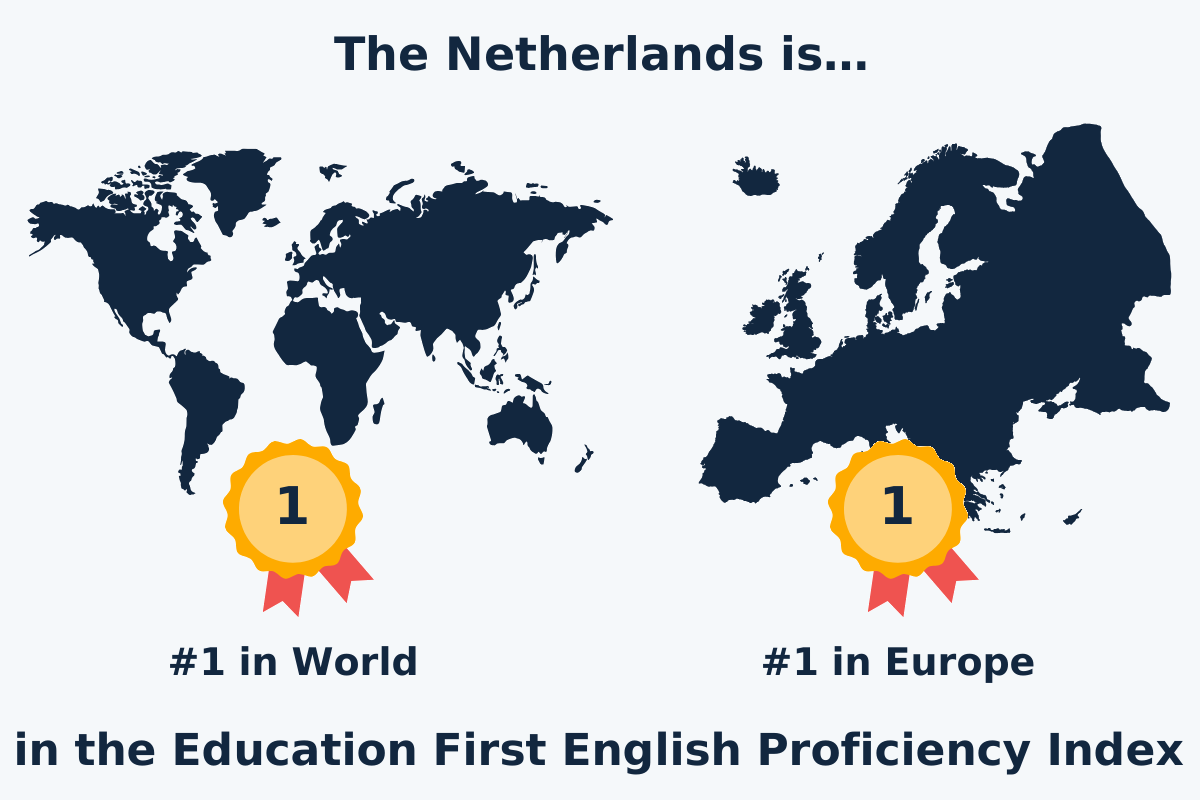
You might have already heard that the Netherlands is the world’s best English-speaking country. Although English isn’t an official language in the Netherlands, almost everyone speaks it to some degree. Not only that, but the level of English spoken in the country is also very high.
The latest statistics show that at least 9 in 10 Dutch people speak English. As for the English skills in the Netherlands, the EF English Proficiency Index placed the Netherlands first in the world for six consecutive years, including in 2024. Currently, people in the Netherlands speak the best English in Europe and worldwide.
Keep reading to discover more interesting facts about English in the Netherlands!
What Percentage of People in the Netherlands Speak English?
The majority of the Dutch population over the age of 15 can speak at least one foreign language. English is the most popular second language in the country, by a landslide. Here are the numbers from the latest Eurobarometer report:
- 90% of Dutch survey respondents said they spoke English well enough to have a conversation.
- Of the 94% of respondents who spoke at least one foreign language, English speakers made up the majority.
- 75% of foreign language speakers said they could follow the news on TV or radio in their target language.
- 72% could read a newspaper or magazine in their second language.
- 62% said they can use their second language to communicate online.
It seems that the vast majority of Dutch people know English at least at a conversational level. The majority of foreign language speakers, most of whom speak English, also have good listening, reading, and writing skills.
Being able to follow the news in regular spoken English and reading a newspaper in written English would require a CEFR level of B2 (intermediate) or C1 (advanced).
In other words, almost all people in the Netherlands know conversational English (B1-B2 level), while 55-66% of people have listening, reading, and writing skills at a level of B2 or C1 (or higher).
It’s hard to pinpoint the actual level for certain, as the Eurobarometer survey relies on self-reported data, and the questions don’t differentiate between the complexity and difficulty of language reception and use. These factors make the difference between intermediate and advanced levels, as you can see in the assessment chart below:
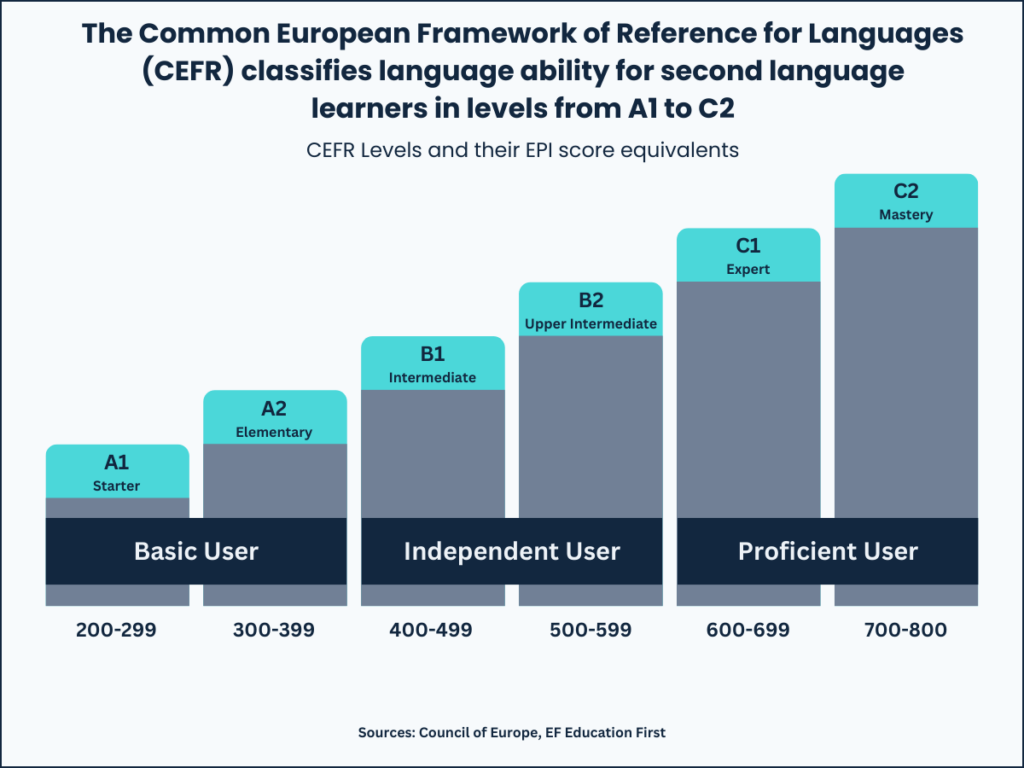
Many of the English speakers surveyed likely had a C1 level in English. As proficiency data shows, the average English speaker in the Netherlands has an excellent grasp of the English language. Since the 2012 Eurobarometer report, the proficiency level in the Netherlands has increased even more.
Sources: Eurobarometer, Education First, Council of Europe
Number of English Speakers in the Netherlands (General Stats)
The Netherlands is a small country. By total numbers, people in the Netherlands make up just 0.8-1% of the world’s two billion English speakers. And yet, the Dutch have the best English proficiency in the world.
Let’s take a closer look at English language trends in the world’s #1 anglophone country:
-
Roughly 15.9 million people in the Netherlands speak English as a second language.
-
Just 1% of people who live in the Netherlands speak English as their native language.
-
The Netherlands has consistently been the world’s #1 most proficient country over the past few years. The Dutch got first place in the EPI ranking throughout 2019-2024, as well as in 2016 and 2017.
Between 2011 and 2015, and again in 2018, the Netherlands ranked either second or third place worldwide. Since then, the proficiency scores have been steadily increasing.
-
In the 2024 edition of the EPI, the average English proficiency in the country was very high (C1 level).
-
All age groups included in the EPI (18-41+ years old) have very high English proficiency. Dutch people aged 21-40 years old had the best English proficiency scores overall.
-
The English proficiency doesn’t differ much across the country. The Dutch speak great English, irrespective of region.
-
The youth and young adults are slightly more likely to speak a foreign language, English included. The 2012 Eurobarometer report shows that 94% of Dutch people aged 15 and up spoke one foreign language.
A subsequent 2016 Eurostat survey showed that 86% of Dutch adults aged 25-64 years old knew at least one foreign language.
9. English is compulsory in Dutch schools. In fact, English has been a mandatory subject in schools since the 1980s.
According to a recent Eurostat study, close to 98% of Dutch pupils in lower secondary education in 2021 were studying English. This was up 1% since 2013.
10. Dutch children begin learning English from a young age, typically 10 years old or younger.
It’s pretty clear that the English language is very widely spoken in the Netherlands. This is nothing new. Since the first EPI report published in 2011, the Netherlands has been in the top 3 best English-speaking countries in the world.
And English is becoming even more popular. The average national proficiency score has only increased since the first EPI report, although English proficiency in the Netherlands was already very high in 2011.
The overall share of fluent English speakers is also increasing with each generation, as there’s an increasingly strong emphasis on learning English and other foreign languages.
In the 2006 Eurobarometer report, 87% of Dutch respondents claimed to speak English, compared to 90% in 2012. Either way, it would be more difficult to find Dutch people who don’t speak English to some extent, especially among those under 50 years old.
Sources: Eurobarometer 1 & 2, Languageknowledge.eu, Education First, Eurostat 1 & 2, Taylor & Francis
Where in the Netherlands Is English Widely Spoken?
Being the second most widespread language after Dutch, English is widely spoken everywhere in the Netherlands.
However, according to a 2016 Eurostat survey, Dutch people living in cities are more likely to claim excellent foreign language skills, compared to those living in towns, suburbs, and rural areas.
Urban populations typically have more English speakers of all levels, including those who are very proficient. Going by total population and degree of urbanization, the Dutch regions with the most fluent English speakers are likely to be:
- Utrecht
- Noord-Holland (North Holland)
- Zuid-Holland (South Holland)
- Gelderland (Guelders)
- Noord-Brabant (North Brabant)
When looking over English proficiency scores provided by EF, we can see that all regions in the Netherlands have great English skills. Surprisingly, none of the five most urbanized and densely populated regions in the Netherlands were among the top best ranked in 2024.
The regions with the highest level of English fluency last year were:
- Overijsse
- Flevoland
Below is the full list of Dutch regions by EPI scores:
| Region | EPI Score | Proficiency Level | CEFR Level |
|---|---|---|---|
| Overijsse | 668 | Very High | C2 (Advanced) |
| Flevoland | 652 | Very High | C2 (Advanced) |
| North Holland | 650 | Very High | C2 (Advanced) |
| Limburg | 650 | Very High | C2 (Advanced) |
| Groningen | 645 | Very High | C1 (Advanced) |
| South Holland | 644 | Very High | C1 (Advanced) |
| Gelderland | 640 | Very High | C1 (Advanced) |
| Utrecht | 636 | Very High | C1 (Advanced) |
| North Brabant | 636 | Very High | C1 (Advanced) |
| Friesland | 633 | Very High | C1 (Advanced) |
| Zeeland | 620 | Very High | C1 (Advanced) |
In any case, all regions in the Netherlands have very high English proficiency on average, despite score differences of up to 48 points.
As for cities in the Netherlands, province capitals and large municipalities tend to stand out and attract the English-speaking demographic, be it university students, young adults, and college-educated professionals working in large corporations.
It’s especially common to hear English in Amsterdam, the capital of the country, as well as other major cities like:
- Utrecht
- Rotterdam
- The Hague
These are just some of the largest metropolitan areas in the Netherlands. However, even smaller cities have very high English proficiency on average. Here’s a chart of 11 Dutch cities included in the EPI last year:
| City | EPI Score | Proficiency Level | CEFR Level |
|---|---|---|---|
| Amsterdam | 657 | Very High | C2 (Advanced) |
| Utrecht | 646 | Very High | C1 (Advanced) |
| Rotterdam | 639 | Very High | C1 (Advanced) |
| The Hague | 636 | Very High | C1 (Advanced) |
The average level of English remains very high throughout the country.
Sources: Eurostat, Education First
English Speakers in the Netherlands by Demographic Group
Age, socioeconomic status, and education level are the main factors influencing foreign language skills in most countries.
The same is true for the Netherlands, although differences among groups are not as stark. Let’s take a look at the numbers:
- The majority of Dutch people know at least one foreign language regardless of age. In a 2016 European survey, 80% of those aged 55-64 claimed to know one or more foreign languages. Among Dutch people aged 25-44 years old, the proportion was roughly 90%.
- Over 40% of Dutch people aged 25-44 years old reported being proficient in a foreign language. Only around a third of those aged 45-54 years old claimed foreign language proficiency. Those aged 55-64 years old were the least likely to report excellent language skills.
- Dutch people over the age of 55 years old are less likely to speak English, but more likely to speak French as a foreign language, according to Eurobarometer data.
- Among English speakers exclusively, all age groups included in the English Proficiency Index have very high scores. Dutch people aged 26-30 years old had the best scores in 2024, followed by those aged 31-40 years old.
- English proficiency was steadily increasing in the 41+ years old group since 2016. In 2016, the proficiency level within this group was high, with an average score of 586 points. By 2024, the average score was 638 points, which corresponds to the very high proficiency band.
- Both men and women have very high English proficiency on average. Although men’s and women’s scores have historically been similar, women’s proficiency scores have been decreasing since 2021. In 2024, men’s average EPI score was 646 points, while women scored an average of 627 points.
- The biggest differences in self-reported language skills were related to education and occupation. Roughly half of Dutch people with a college education claimed excellent language skills, compared to just a third of those with a high-school or vocational education in the same 2016 European survey.
- Nearly half of those working in healthcare, science and engineering, IT and communication, business and administration, and teaching, as well as legal, social, and cultural professionals, claimed to speak a second language proficiently. Only around a third of those working in services, sales, and clerical support said the same.
- More Dutch people living in cities claimed to be proficient in a foreign language, compared to those living in towns, suburbs, and rural areas. However, the difference between urban and rural environments isn’t that pronounced.
To summarize, English is the most common foreign language in the Netherlands, especially among adults under 55 years old. English proficiency is highest among Dutch people aged 21-40 years old, particularly those with a college education, and those working in healthcare, education, IT, science, business, and other related fields.
So, how reliable are these figures?
With the exception of the EPI, which actively tests the English language skills of participants, the most recent surveys rely on self-reported data. Those in the Eurostat survey could classify their foreign language skills as either “proficient,” “good,” or “basic.”
While certain demographics were more likely to describe themselves as “proficient,” there was no further distinction between those with “good” or “basic” language skills. That said, only 21% of all Dutch people in the survey reported “basic” foreign language skills.
Remember, almost everyone knows English in the Netherlands. Even most of those with less-than-perfect English, likely have a good grasp of the language. Only 1 in 10 Dutch people can’t speak at least some English.
Among those who know English, roughly 1 in 5 can use the language at a basic level (possibly the equivalent of CEFR level of A2). The vast majority of the Netherlands’ population knows English well enough to have a conversation even with a native speaker.
Sources: Eurostat, Languageknowledge.eu, Education First
Conclusion
English is very common in the Netherlands. In fact, the English language is the second most widely spoken besides Dutch. The vast majority of people in the Netherlands have at least some English knowledge, and the average English level is very high. In other words, most Dutch people can speak English fluently.
According to English proficiency data, the Netherlands is the best English-speaking country in the world. Young Dutch people are especially likely to speak excellent English. Less people over the age of 55 know English, though almost a third of this age group reported speaking the language in past surveys.
FAQs
1. What languages are spoken in the Netherlands?
Dutch is the official language in the Netherlands. Besides the official language, the Netherlands also has several recognized regional languages. Some of these include Frisian, Limburgish, and Dutch Low Saxon. English is also a regional language in the Netherlands’ Caribbean Islands.
Most Dutch people speak Dutch as a mother tongue, and one or more foreign languages, including English, German, and French. English and German are the most commonly spoken foreign languages in the Netherlands and the most widespread languages besides Dutch.
2. Why are the Dutch so good at speaking English?
There are multiple potential reasons why many Dutch people speak English so well. The English education in the Netherlands plays a big part, as the English language has been a mandatory school subject for many years, and Dutch pupils begin learning English at an early age. The Dutch and English languages are also quite similar, which makes learning a lot easier.
Dutch people also get a lot of exposure to the English language through TV shows, movies, and similar media. Almost all foreign content comes in the original language, with added Dutch subtitles. Finally, English is often a requirement for jobs in various industries, given the Netherland’s big international presence.
3. Are English and Dutch similar?
Yes, English and Dutch are quite similar in many aspects. Both English and Dutch belong to the same West Germanic language family. The two languages share a lot of similarities in terms of vocabulary, grammar, and phonetics.
The Dutch language is one of the easiest languages to learn if you already know English. According to most estimates, it takes roughly 700 study hours to become fluent in Dutch if you learn Dutch as a native English speaker. The reverse is also true. English is very easy to learn for native Dutch speakers.

Written by Diana Ploscaru
Diana is a trilingual ESL teacher and writer with a M.A. in Translation and Terminology. She has spent over 10 years studying English, German, and philology, and now wants to share her knowledge and passion with other linguistics enthusiasts.